




Exploring the Average Cost of Living in Australia: An In-Depth Analysis


Author | Steve Blackwell
 relocationswa.com/about/steve-blackwell
 linkedin.com/in/steve-blackwell
Australia has always been a popular destination for those chasing a new life. Whether you’re starting a family, seeking a career boost, or yearning for an outback adventure, it has something for everyone. But before you pack your bags, be aware that the laid-back Aussie lifestyle might come with a higher average cost of living in Australia than you expect.
This article will be your one-stop shop for understanding the average cost of living in Australia. We’ll cover everything from wages and taxes to housing, utilities, and education. So, ready your moving house checklist, moving overseas checklist, and change of address checklist because we’re in for a ride.
How Is the Average Cost of Living in Australia Measured?
The price of living in Australia, like housing, bills, gas, and food, has increased. This makes people worried about how much it costs to live there overall. To figure this out, you need to look at a wide range of expenses for different households, not just a few things.
The cost of living depends on several factors, such as the cost of basic needs, how easy it is to afford things in general, and how price changes affect people in different parts of the country.
The Australian government uses a few tools to track the cost of living:
- The Consumer Price Index (CPI) measures how much the value of goods and services goes up or down.
- Living Cost Indexes (LCIs) measure the cost of maintaining a certain standard of living.
- Wage Price Index (WPI) measures how wages, incomes, and the cost of labour change across different industries.
What Is a Good Salary in Australia?
The average cost of living in Australia to have a comfortable file can vary significantly depending on your circumstances. Location plays a major role, with big cities like Sydney and Melbourne generally requiring a higher income than regional areas. Your lifestyle choices also come into play.
As a rough guide of ‘What’s a good salary in Australia?’, a single person living outside a major city might need an annual income of $70,000 to $80,000, which translates to roughly $5,800 or more per month.
This figure can provide a decent standard of living, but remember, it’s just a starting point. Couples and families will require a higher income to maintain a comfortable lifestyle, as their expenses for housing, groceries, and other necessities will be multiplied.
Average Wage of an Australian
Numbers floating around might suggest they earn an average yearly salary in Australia around $90,000, but that’s before taxes and can vary wildly depending on your experience, what field you work in, and even where you live in the country.
According to the Australian Bureau of Statistics (ABS), in November 2023, average wage of an Australian is $1,888.80 weekly, adding to about $98,000 annually. But it’s important to note that this is an average, and the middle ground, or mean salary in Australia, is closer to $65,000. So, while some Australians earn a high Aus average wage, there’s a big spread of income across the country.
Average Wage of an Australian by State / Territory
- New South Wales and Victoria: Full-time workers in New South Wales and Victoria earn close to the Australia national average salary, with weekly earnings around $1,830. Sydney and Melbourne, the biggest cities in these states, have slightly higher average Australia income, sitting around $80,000 and $75,000, respectively.
- Queensland: Full-time workers in Queensland earn slightly less weekly than the Australia national average salary, at roughly $1,791. Brisbane, the major city, has an average yearly salary in Australia of $73,000.
- South Australia and Tasmania: South Australia falls below the national average by a more significant margin, with full-time workers earning around $1,677 per week, making the cost implications of moving to South Australia worth considering. Tasmania has the lowest average weekly earnings at $1,619.
- Western Australia: Full-time workers in Western Australia earn the most, with an average weekly income exceeding $2,000. Perth, the largest city, reflects this trend with a higher average annual salary of $77,000.
- Northern Territory and Australian Capital Territory: The Northern Territory’s weekly earnings are slightly lower than the national average, at $1,775. The Australian Capital Territory has the second-highest average weekly earnings, with full-time workers making roughly $2,022.
Average Cost of Living in Australia
Australia generally sits above the global average in terms of expenses. While exact figures can vary depending on your lifestyle and location, expect to spend more on housing, groceries, and utilities compared to many other countries.
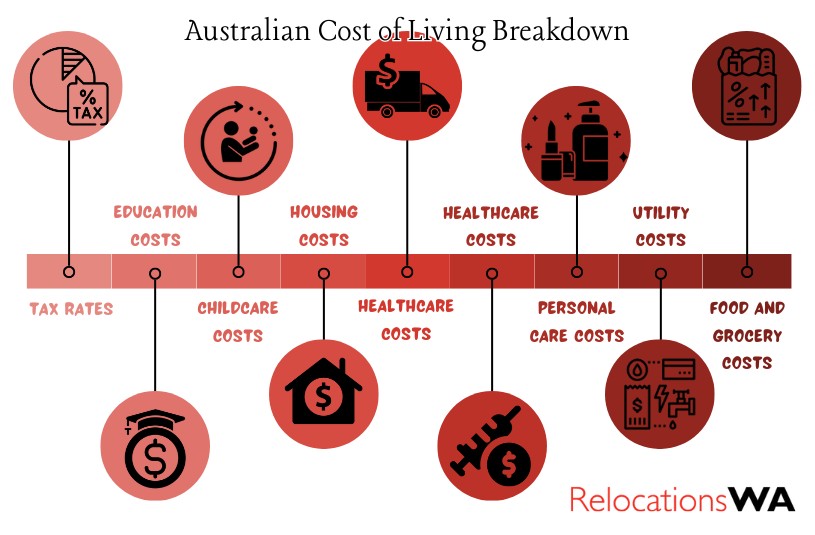
Want to get more specific? Let us provide a more detailed average Australian cost of living breakdown!
Cost of Living in Australia: Tax Rates
In Australia, income tax is determined by earnings. There is no tax on income below $18,200 per year.
For income exceeding $180,001, a flat fee of $51,667 applies, plus an additional 45 cents for each dollar earned above $180,000. A table with income brackets and corresponding tax rates is available for further details.
| Taxable Income | Tax on this income |
| 0 – $18,200 | Nil |
| $18,201 – $45,000 | 19c for each $1 over $18,200 |
| $45,001 – $120,000 | $5,092 plus 32.5c for each $1 over $45,000 |
| $120,001 – $180,000 | $29,467 plus 37c for each $1 over $120,000 |
| $180,001 and over | $51,667 plus 45c for each $1 over $180,000 |
How to Save Money on Tax Rates
Saving on taxes in Australia is about strategically lowering your taxable income. Here are some ways to achieve this:
- Claim Deductible Work Expenses: If you incur work-related costs like travel, phone bills, or union fees, you can claim them as deductions, reducing your taxable income. Keep accurate records of these expenses throughout the year.
- Offset Options: Australia offers various tax offsets that reduce your tax payable. These may include offsets for private health insurance, low-income earners, or those with certain medical conditions. Research which offsets you might be eligible for.
Cost of Living in Australia: Education Costs
The cost of school can vary greatly depending on the type of school and location. Public primary schools are the most affordable option, with annual fees of around $158. Independent secondary schools are the most expensive, averaging up to $12,860 annually. There are also differences between states and territories.
For University fees, the Australian government helps fund universities, but students still have to pay a portion of the fees. This contribution can range widely, from $8,500 to a substantial $94,000 per year.
Adjustments made in 2021 to how universities receive funding affected the cost of some degrees, making some cheaper and others more expensive.
How to Save Money on Education Costs
The quest for knowledge shouldn’t break the bank. Here’s a toolkit to navigate education expenses and emerge victorious:
- Consider Alternatives: Public universities and TAFE institutions typically offer lower fees than private institutions. Explore online or part-time programs that can be easier on the wallet.
- Seek Scholarships and Grants: A treasure trove of scholarships exists! Research scholarships are based on academic merit, financial need, or even specific fields of study. Government grants can also offer significant financial aid.
Cost of Living in Australia: Child Care Costs
The cost of childcare can vary significantly depending on your location. While the national average sits around $130 per day, some cities like Sydney can be much pricier, reaching up to $178.
Here’s a breakdown of average daily costs in some major cities:
- Brisbane: $150.22
- Melbourne: $162.28
- Adelaide: $123.36
- Perth: $157.18
- Canberra: $157.66
Regional areas offer some more affordable options, with prices in cities like Cairns and Broome as low as $115 and $121 per day, respectively.
How to Save Money on Child Care Costs
Childcare is a significant expense for many families, but there are ways to make it more manageable. Here are some strategies to consider:
- Child Care Subsidy (CCS): Australia’s Child Care Subsidy offers financial relief for eligible families. Explore the CCS and ensure you receive the maximum benefit for which you qualify.
- Family and Friends: Consider if grandparents, aunts, uncles, or close friends can provide childcare support.
This can significantly reduce costs, especially for occasional needs.
Housing and Property Prices
As of June 2024, the median house price across Australia’s combined capital cities is $975,592.
If you’re asking about ‘How much is rent in Australia?’ The data on the average rent in Australia is less readily available, but vacancy rates can provide some insight. A lower vacancy rate typically indicates a tighter rental market and potentially higher rents. As of June 2024, the national vacancy rate sits around 1.2%.
To get various housing and property market data, you can check the Australian Bureau of Statistics (ABS).
How to Save Money on Housing
- Contact your bank annually to inquire about a lower interest rate.
- Refinancing with a different lender might offer a better deal.
- Discuss options with your lender, such as extending the loan term, temporarily pausing payments, or switching to interest-only payments (if eligible).
Cost of Living in Australia: Transportation Costs
Major cities have extensive public transport networks with buses, trains, trams, and ferries. Fares vary depending on the distance travelled and concessions available. Expect to pay between $2.20 and $8.69 for single fares in capital cities.
For cars, it can be expensive. Fuel prices fluctuate. When calculating costs, factor in car loan repayments, insurance, registration, and tolls. The average household spends around $384.86 weekly on car-related expenses.
Domestic flights can be a good option for longer distances. Prices vary depending on route, airline, and time of booking. Budget airlines can offer competitive fares, while full-service carriers might be pricier.
How to Save Money on Transportation
Opt for public transport, walking, or cycling to save on gas, tolls, and parking. Consider whether you even need a car!
Find the cheapest gas in town! Some apps help you compare prices and even get notified when prices drop.
If you’re due for a new car, consider an electric vehicle. The upfront cost might be higher, but you’ll save on fuel in the long run.
Healthcare Costs
Australia boasts a universal healthcare system, Medicare, which provides essential medical services to citizens and permanent residents. However, navigating the full picture of healthcare costs can be more nuanced. Here’s a breakdown to help you understand what to expect:
- Medicare Coverage: Medicare covers a significant portion of the costs associated with general consultations with doctors and specialists, diagnostic tests, and some hospital treatments. However, it doesn’t cover everything.
- Out-of-Pocket Costs: Even with Medicare, expect to pay some out-of-pocket expenses. These can include “gap payments” charged by doctors or specialists, medication co-pays, and ambulance fees.
You can check Medicare Australia. They provide information about Medicare coverage and benefits.
Cost of Living in Australia: Personal Care Costs
While the average Aussie spends around $1447 monthly on discretionary spending, younger people tend to tighten their belts on non-essentials. Entertainment includes everything from going to the movies to pub outings and can range from $80 to $150 a week. Overall, Australians are feeling the pinch of rising costs, but there’s still room for some fun in the budget.
Cost of Living in Australia: Utility Costs
Changing utilities is one of the first things you do when moving but, utility bills can take up a significant chunk of your budget in Australia. The average household pays around $165 per month for electricity, with prices varying depending on your state, how much energy you use, and the efficiency of your appliances. Gas bills come in at an average of $66 monthly. Water costs can also fluctuate but typically average around $75-$110 per month, depending on household size.
How to Save Money on Electricity and Gas Utilities
Switch to the cheapest provider regularly. It’s easy—comparison sites can help you find the best deal in minutes!
- Use less: Small changes make a big difference. Turn off electronics, seal leaks, run appliances efficiently, and choose cooler/warmer settings when possible.
- Fuel your savings: Consider switching to electric appliances, especially with recent gas price increases.
- Invest in efficiency: When replacing appliances, choose energy—and water-efficient models. For bigger savings, consider upgrades like insulation, LED lights, solar power, or heat pumps for hot water.
Cost of Living in Australia: Food & Grocery Costs
Australia food prices can put a decent dent in your wallet. According to Finder, Aussies spend roughly $188 per week on groceries, translating to around $752 per month for a household. This figure can vary depending on several factors.
Household size can be a factor on the food prices in Australia. Singles spend around $100 a week, while larger families with five or more people can fork over $200 weekly.
How to Save Money on Groceries
Don’t just chase discounts! Here’s how to lessen your cost of food in Australia and get the most out of your grocery shopping:
- Bulk buying can save money, but only if you use everything. Frozen, canned, and even imperfect-looking produce can be cheaper and as nutritious as fresh options. Consider refillable products, too.
- Reduce meat in some meals with cheaper protein options like lentils. Skip sugary drinks and other non-essential items. If you have time, consider making things from scratch to save money.
Cost of Living in Different Australian Cities
Aussie dreams come with Aussie prices! Costs vary across cities. Research your ideal city for a clearer picture.
Cost of Living in Sydney
The cost of living in Sydney, Australia can be pricey! A significant portion goes towards rent, which has an average Sydney rent of $3,261.50 for a one-bedroom apartment. Even living expenses in Sydney, Australia, like basic utilities, cost around $327.19 per month for an 85-square-metre apartment. Compared to other Australian cities, the cost of living in Sydney is relatively high.
Cost of Living in Brisbane
The living expenses in Brisbane is a more affordable option than Sydney. The monthly cost, excluding rent for a family of four, is estimated to be around $6,251.50. For a single person, the average monthly cost is estimated at $1,773.70. Utilities for an 85-square-metre apartment cost around $342.36 per month. Renting a one-bedroom apartment in the city centre costs roughly $2,600 per month.
Cost of Living in Melbourne
Melbourne is another attractive option for those looking for a cheaper alternative to Sydney. The monthly cost of living in Melbourne, excluding rent, is estimated to be around $6,200 for a family of four and $1,746 for a single person.
Renting an apartment is also notably cheaper in Melbourne, with an average 21.5% reduction in rent prices compared to Sydney. However, living expenses can vary greatly between neighbourhoods, with some of the richest suburbs in Melbourne commanding much higher costs.
Cost of Living in Canberra
Canberra might surprise you! Everyday expenses (excluding rent) are 15% more expensive than in Sydney, despite rents being an average of 23.2% lower. This means for groceries, utilities (other than rent), and other expenses, you’ll pay a bit more in Canberra. However, you’ll make up some of that difference with cheaper rent.
➜ You can check a more detailed cost of living in Canberra here.
Cost of Living in Perth
The cost of living in Perth, Australia is a more affordable lifestyle than Sydney despite being around 3% more expensive overall. Here’s the breakdown:
- For a family of four, excluding rent, you’d expect to spend around $6,455.30 monthly on everyday expenses.
- For a single person, monthly costs without rent are estimated to be around $1,836.
The most significant advantage is rent, costing an average of 29.2% less than in Sydney. So, while everyday expenses might be a tad higher, you’ll make significant savings on rent.
Living Costs: Australia vs UK
Money matters when moving to another country! To avoid surprises, comparing living expenses between your current home and your potential new one is important. We will help you with that by providing a detailed breakdown of the cost of living in Australia compared to UK.
Cost of Living in Australia vs UK: Housing
Finding a place to live is a big cost factor, no matter your living situation. While the UK and Australia have a reputation for expensive housing, the price range is similar.
Living Costs Australia vs UK: Renting
Renting is a common option because it offers flexibility and lets you find a place quickly when you arrive.
- Australia: Renting tends to be pricier than in the UK, especially in big cities like Sydney. Expect to pay roughly 10% more.
- UK: Renting is generally more affordable, particularly outside of London.
Living Costs Australia vs UK: Buying a House
House prices vary greatly depending on where you live in either country. It’s best to consult local real estate agents for the most up-to-date figures.
- Australia: Generally pricier, especially in big cities like Sydney and Melbourne.
- UK: Historically, it has been more affordable, especially outside London. However, house prices have been rising recently, narrowing the gap between the two countries.
Living Costs Australia vs UK: Utility Bills
- Australia: Brace yourself for pricier electricity bills, especially when air conditioning kicks in in the summer—budget around $165 per month on average. Gas is a bit cheaper, averaging $66 per month. Water costs vary, but expect to pay around $90 monthly.
- UK: Electricity is generally cheaper than in Australia, although prices are rising. Gas is more commonly used for heating than in Australia, so your bill could be higher depending on usage. Water tends to be less expensive than in Australia.
Cost of Living in Australia vs UK: Food Prices
Surprisingly, groceries in Australia can be up to 35% more expensive than in the UK. This is likely because Australia imports much of its food, and transportation costs increase.
Cost of Living in Australia vs UK: Transportation Cost
Australia generally offers better deals on car purchases, sometimes up to 35% cheaper, depending on the model.
However, you’ll likely pay more for petrol in Australia, around £0.50 per litre more than the UK.
Monthly passes tend to be cheaper in major Australian cities than in London, and single fares are similar in price across major cities in both countries.
Cost of Living in Australia vs UK: Recreation Costs
No matter your reason for moving, remember to factor in recreation costs. It’s to prevent stress of moving house. While both Australia and the UK boast amazing things to do, from catching a game to exploring museums, entertainment in Australia can be a bit pricier.
The UK might have more budget-friendly options, especially for culturally enriching activities like museums and historical sites.
Living Costs Australia vs NZ
Overall, the cost of living is lower in New Zealand than in Australia. However, both countries offer a high standard of living. While New Zealand has cheaper everyday items and services, Australia makes up for it with higher salaries.
The most cost-effective country depends on you! Consider your priorities, lifestyle, and where you plan to live in either country.
Housing Costs: City vs. Suburbs
No matter which country you choose, finding a place to live will be a significant expense. Here’s the breakdown:
- Generally cheaper in smaller towns: Renting an apartment in a smaller town is more affordable than in big cities like Sydney, Melbourne, Auckland, or Wellington. This is because of things like lower demand and smaller populations.
- Australia’s pricier cities: If you move outside the city centre, expect to pay 15-20% more in rent in Australia compared to New Zealand. This gap widens in city centres, where rents can be up to 26% more expensive in Australia.
- East Coast advantage: Consider smaller towns or suburbs on the East Coast of either country. You might find the same apartment cheaper than big city centres.
Essential Expenses: Groceries, Electricity, Water & Gas
Beyond rent, everyday costs add up, too. Here’s a breakdown of groceries and utilities:
- Groceries: New Zealand offers a clear advantage! Groceries are surprisingly 8.5% cheaper on average, making them a better choice for budget-minded shoppers.
- Utilities: Another win for New Zealand! Utilities are a whopping 33.6% cheaper on average compared to Australia. The only exception is the Internet, which costs about the same in both countries. Overall, New Zealand seems like the more affordable option for everyday expenses.
Transportation Expenses
While New Zealand might be cheaper for rent and daily needs, transportation costs could differ. Interestingly, New Zealand prioritises sustainable travel options. They encourage things like video conferencing and electric vehicles to reduce pollution. This might not directly impact your cost of living, but it shows their commitment to a greener future, which some might value highly.
How Much Does It Cost to Relocate to Australia?
Many Brits make the move to Australia, but planning is key. Depending on your situation, international relocation costs can vary (expect £5,000-£15,000).
We can help! At Relocations WA, we specialise in smooth UK-to-Australia or NZ-to-Australia moves and vice versa. We’ve guided countless people through the process, ensuring a stress-free transition.
We also handle moves within Australia. We can help transport your pets safely and securely, and we’ll handle the logistics if you want to take your car on a moving adventure.
Ready to make your move a reality? Don’t let the details slow you down. Contact Relocations WA today for a free consultation and let our expert team craft a personalised plan for your Australian dream. Together, let’s make your relocation a success story!
Moving house?
You might also like

Richest Suburbs in Perth: Where Interstate Movers Find Premium Living
We often speak with families, professionals, and downsizers who are moving to Perth because they want more than a new address. They want space, better lifestyle balance, beautiful beaches, access to the Swan…

Worst Suburbs in Melbourne: What You Should Know Before Relocating
Melbourne is one of Australia’s most popular relocation destinations, and it is easy to see why. It has strong job opportunities, great food, major universities, family-friendly pockets, and plenty of lifestyle variety. But…

Best Suburbs in Melbourne: Finding the Right Melbourne Suburb for You
Melbourne stands out as one of the world’s most livable cities thanks to its strong healthcare system, high-quality education, vibrant culture, reliable infrastructure, and overall stability. It currently ranks as the top city…




