




Cost of Living in Ireland vs Australia


Author | Steve Blackwell
 relocationswa.com/about/steve-blackwell
 linkedin.com/in/steve-blackwell
“What’s the difference between the cost of living in Ireland vs Australia?”
“Is it cheaper to live in Ireland or Australia?”
It’s a fair question—and one that doesn’t have a simple answer.
Both countries are English-speaking, offer good employment opportunities, and provide a high quality of life, but the expenses of day-to-day living are quite different once you get there.
It is equally important to understand the financial realities on the ground as much as it is to organise visas and transportation.
People who make proper plans when moving overseas based on a realistic breakdown of the cost of living in Ireland vs. Australia are likely to settle more quickly and avoid ugly surprises.
It assists in deciding where your money will stretch further, how much you can actually afford to live and what sacrifices you might have to make, or not.
Overview of Cost of Living in Ireland vs Australia
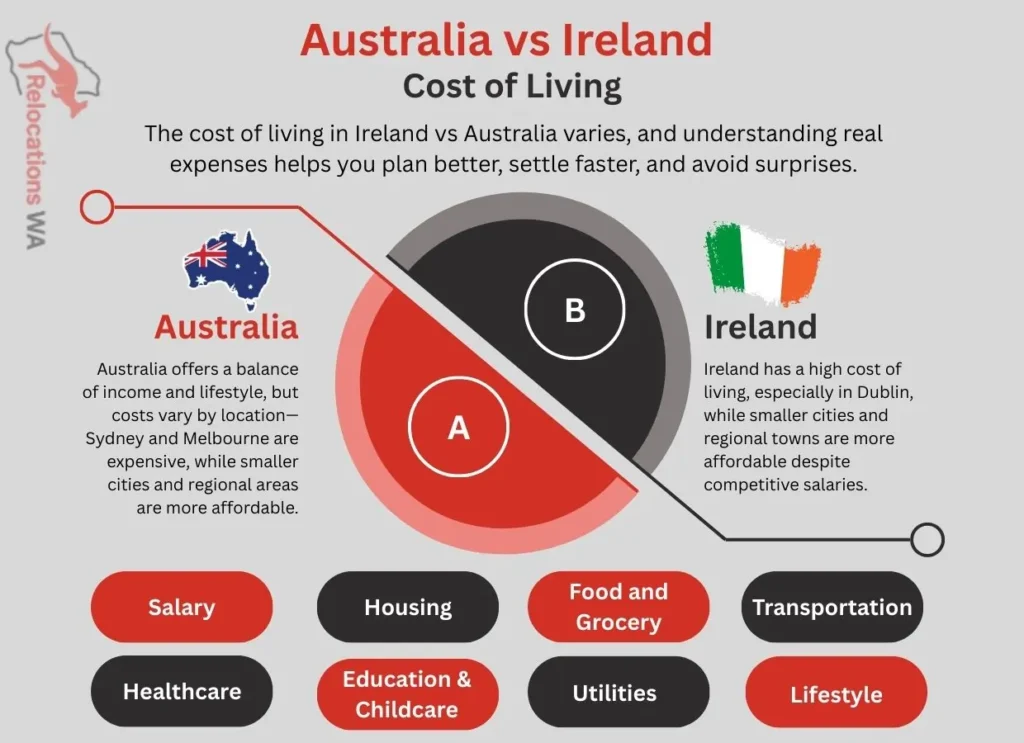
When comparing the cost of living in Ireland vs Australia, many people think of Ireland as a high-priced country, especially for newcomers moving to major cities.
Though salaries are also competitive in areas like technology, healthcare, and finance, the daily cost of living can quickly add up.
Dublin is, by all means, the most expensive city in the country; rent is expensive, housing is in short supply, and competition is high.
Regional towns and smaller cities (e.g., Cork, Galway, Limerick, Waterford), on the other hand, offer lower rents and a lower cost of living.
The cost of living in Australia, on the other hand, has been perceived as a good balance between earning and lifestyle for people planning an international move.
However, when comparing the cost of living in Ireland vs Australia, one should note that location, wages, and daily habits can significantly affect the total cost.
Cities such as Sydney and Melbourne are consistently among the most expensive places to live in Australia.
Smaller cities and regional areas—such as Adelaide, Brisbane, Perth, or regional New South Wales—tend to offer more affordable housing and a lower overall cost of living.

Cost of Living in Ireland vs Australia: Salaries
Understanding how taxes and salaries work is vital when taking the step of moving to Ireland, Australia, or a foreign country.
When rent, groceries, and utilities are factored in, your income and what you retain after taxes play a significant role in managing your day-to-day budget.
The following is a comparison of Ireland and Australia regarding earnings and tax burdens, which is fundamental to avoid a stressful move.
Ireland
- On average, the wage in Ireland is approximately €52,800, and that amounts to an average of €3,427 per month after tax for a typical full-time employee.
- Higher wage payments are concentrated in industries such as tech, finance, healthcare, and professional services.
Australia
- The average Australian monthly salary after tax is estimated to be higher than in Ireland, at about $3,826 AUD (~€2,590).
- The well-paid markets in Australia are engineering, Information Technology, finance, and healthcare.
When comparing the cost of living in Ireland vs Australia, it’s not just about gross salary — after-tax net income and how it aligns with local prices matter just as much for budgeting post-relocation.
Cost of Living in Ireland vs Australia: Housing Costs
When comparing Ireland vs Australia cost of living, housing is one of the biggest factors that can make or break your budget — especially if you’re planning a change of address.
Let’s break down the major elements migrants care about: renting, buying, utilities, and market competitiveness.
Rent Comparison (City Centre vs. Suburbs)
Ireland
- In Dublin, the most costly city, an apartment in the city centre with one bedroom will generally cost between €2,000–€2,400 per month, and an apartment outside the city centre will cost about €1,600–€1,900 per month. Smaller cities such as Galway or Cork can be slightly cheaper yet still higher than most cities in Europe.
- The national rent rate is increasing alarmingly, with Dublin recently exceeding €2,500/month and other cities such as Cork following close behind.
Australia
- Premium rents are also common in major cities: in Sydney, a 1-bedroom in the city centre would cost about A$3,000 (~€1,900). Melbourne and Brisbane are a little cheaper but still expensive.
- Rental prices in Australia tend to be slightly cheaper than those in Ireland after currency is factored in, especially when taking a countrywide view rather than a city-centre-only one. Rent (under the housing category) is usually about 17–23% lower in Australia than in Ireland.
Buying Property Costs
Ireland
- The price of a house has soared, especially in Dublin, where the average sale price is well above €450,000–€650,000, depending on the location.
- The limited housing supply keeps prices high relative to income, a persistent challenge for first-time buyers.
Australia
- Property prices vary widely: Sydney usually takes the top spot, with high per-square-metre rates (approximately A$10,000–A$13,000 in the city centre), while regional cities are slightly more affordable.
- Australia has larger properties at similar prices to Ireland, but sticker prices remain high in the capitals.
For migrants moving with families or planning long-term settlement, buying costs play directly into decisions about where and when to settle.
| Category | Ireland | Australia |
|---|---|---|
| Rent City Centre | Higher in Dublin (~€2,000–€2,400) | Slightly lower in many metro areas (~A$2,500–A$3,000) |
| Rent Suburbs | Lower but still expensive | Often more affordable, wider choice |
| Buying Property | High, especially in Dublin | Also high, but more spread geographically |
| Housing Market Competition | Very tight supply | Competitive but broader options |

Cost of Living in Ireland vs Australia: Food and Grocery
Food and grocery expenses are one of the areas that you will feel in your weekly budget when planning to move to a foreign country. Here’s how Ireland and Australia compare across key daily-life food expenses.
Supermarket Prices
Ireland
- Grocery costs in Ireland are generally 10–12% lower than in Australia.
- Basic supermarket foods such as bread, eggs, fruit, and vegetables are available at affordable prices. To illustrate, a 0.5 kg loaf of white bread will cost under €1, and a weekly grocery shop for a single person will be approximately €50–€90, depending on what you eat and where you shop.
- There have been active price wars over basics, with low-cost supermarkets competing on price that can make a difference for first-time shoppers struggling to make ends meet.
Australia
- Supermarket prices in Australia are relatively high compared to Ireland, particularly for staples such as meat, cheese, and produce.
- Despite higher absolute prices, higher median wages in Australia can help counter them.
- Grocery baskets found Australia ranked third in total cost in a regional analysis, slightly higher than Ireland and lower than a few other neighbouring nations.
When relocating abroad, you might notice that your weekly shopping will cost you more in Australia than in Ireland, but this will always depend on your personal lifestyle.
Typical Monthly Grocery Budget
The following is a rough calculation of the amount an individual spends on groceries per month, which can be used when comparing the living costs in Ireland and Australia:
| Category | Ireland | Australia |
|---|---|---|
| Weekly groceries per person | ~€50–€90 (~€200–€360/month) | Slightly higher proportionally (grocery prices ~10–12% higher) |
| Monthly eating out budget | Highly variable, often €150–€300+ | Similar range, sometimes lower relative to income |
| Coffee & drinks | €3–€5 per café coffee (varies) | Slightly higher or similar in major cities |
Note: All these are estimates and will be dependent on the locality, lifestyle, shopping habits (discount or premium supermarkets), and the frequency of eating out.

Cost of Living in Ireland vs Australia: Transportation Costs
The cost of transport, whether it is your daily travel or the purchase of your own car, is a significant aspect of your budget when you plan to move to a foreign country.
This is a comparison of public transit and car ownership in Ireland and Australia.
Public Transport (Monthly Passes & Reliability)
Ireland
- A single ticket on the transport system in cities such as Dublin would cost approximately €1.80–€4.00.
- Monthly passes are usually between €80 and €150, depending on the city and travel zones.
Australia
- Single tickets in Australian cities such as Sydney, Melbourne, and Brisbane may cost approximately A$4–A$6 and monthly passes are typically in the range of A$120–A$200.
- In big cities, the transport system tends to be efficient, with buses, trains, and trams integrated.
In Australia, monthly pass costs tend to be a little higher in big cities. Still, both nations offer student and commuter concessions, which should be considered when comparing living costs in Ireland and Australia.
Car Ownership (Fuel, Insurance, Maintenance)
Ireland
- The cost of fuel in Ireland is quite high, approximately €1.70–€1.90 per litre.
- Insurance costs may vary, but most drivers spend between €600 and €1,500 per year, as insurance is usually more expensive for new drivers without a local driving history.
Australia
- The average price of petrol is about A$1.50–A$2.00 per litre, and car insurance can range from A$500–A$1,200+ per year, depending on your vehicle model, age, and driving record.
- It is possible to spend over A$300–A$400 per month (fuel, maintenance, and insurance) in Australia to own and operate a car, especially if you commute frequently or live outside major transit corridors.

Cost of Living in Ireland vs Australia: Healthcare Costs
Healthcare is among the most important factors to consider when planning to travel to a foreign country.
In the debate over the cost of living in Ireland vs Australia, there is a wide range of healthcare costs, including coverage under the public healthcare system, private insurance, and out-of-pocket expenses.
Public Healthcare Systems Comparison
The two countries have similar public healthcare systems funded by taxes, though their coverage and accessibility vary greatly.
Ireland
Ireland has a mixed public-private system, with the Health Service Executive (HSE) as the main provider.
Healthcare services are partially subsidised, and most of the population still pays fees unless they have medical cards.
Australia
The Medicare system in Australia offers free or subsidised healthcare to residents and citizens, including hospital care and partial GP coverage.
Private Healthcare and Insurance Costs
Both countries use private insurance to provide faster access and broader coverage.
Ireland
- The prices of private health insurance usually vary depending on age and coverage.
- Almost half of the residents have private insurance due to delays in public systems.
Australia
- Private insurance is encouraged through tax incentives and government rebates.
- Many residents use private coverage for dental, specialists, and elective procedures.
When it comes to Australia vs Ireland living costs, private healthcare premiums are similar, but Australia offers more government support.
Out-of-Pocket Medical Expenses
Out-of-pocket healthcare spending is a key differentiator when comparing relocation costs.
Ireland
- Doctor visit: about €50–€70 per consultation
- Specialist fees can be significantly higher
- Prescription costs are often partially subsidised
Australia
- The average GP visit cost is around AUD 43 out-of-pocket in 2025
- Specialist visits can exceed AUD 600 annually for many patients
These numbers indicate that, even though healthcare in Australia is subsidised, private consultations still contribute significantly to the overall cost of living there compared to Ireland.
Overall Comparison: Healthcare in Ireland vs Australia
| Category | Ireland | Australia |
|---|---|---|
| Public healthcare access | Limited coverage | Broad Medicare coverage |
| Private insurance usage | High | High |
| Overall affordability | Moderate–High | Moderate |
Healthcare is cheaper and more widely available in Australia, which significantly affects the overall cost of living calculation between Ireland and Australia.

Cost of Living in Ireland vs Australia: Education and Childcare Costs
Education and childcare costs can significantly affect the ability to pay long-term costs for families and students who are planning a move.
School fees, college tuition, and childcare expenses in any cost-of-living comparison between Ireland and Australia vary more than anticipated, potentially affecting decision-making.
Schooling (Public vs Private)
Ireland
Ireland offers free primary and secondary education, but the parents are required to pay fees for uniforms, books and voluntary contributions.
These costs may increase a child’s annual expenses by several hundred euros.
- Public schools are common but may be scarce in urban areas.
- There are popular, expensive (up to several thousand euros a year) private schools, especially in Dublin.
- Education-related expenses in Ireland are relatively high compared to average household income, particularly for urban families.
Australia
Public schooling is also available in Australia, although parents usually make voluntary contributions.
- The facilities and funding of public schools are usually better than those of most European schools.
- Private schooling is popular but can be costly, with annual fees of tens of thousands of Australian dollars.
- Comparing the cost of living in Ireland vs Australia, Australia tends to have better-resourced state education systems, but the cost of privatised education is very high.
University Tuition Fees (Local and International)
Ireland
- EU students benefit greatly from subsidised tuition, but registration and student contribution fees are still usually paid.
- International students face much higher fees, particularly for postgraduate and specialist degrees.
Australia
- Domestic students are given government-subsidised places, yet they still pay tuition.
- Fees charged to international students are very high and vary by course and institution.
- Australia has always been one of the more expensive places to study abroad. Still, good post-study work prospects tend to counter this in comparisons of living costs between Australia and Ireland.
Childcare and Daycare Expenses
Ireland
One of the most costly aspects of family life in Ireland is childcare.
- Full-time daycare prices can be high, especially in Dublin and the surrounding areas.
- There are government subsidies, but they may not fully cover the expenses of a high-income household.
- Numbeo claims that in Ireland, the cost of childcare is among the highest in Europe relative to income.
Australia
Childcare is also expensive, particularly in large Australian cities.
- State-provided childcare subsidies significantly reduce the out-of-pocket costs of numerous families.
- Since daycare is not free, it is a significant expense for working parents.
- Childcare costs are high in both countries. Still, financial aid is usually more favourable in Australia, which can influence the cost-of-living comparison between Ireland and Australia.
Ireland vs Australia: Education & Childcare Comparison
| Category | Ireland | Australia |
|---|---|---|
| Public schooling | Free but added costs | Free with contributions |
| Private school fees | High | Very high |
| University tuition (international) | High | High |

Cost of Living in Ireland vs Australia: Utilities and Internet
The cost of utilities and connectivity is often overlooked when planning a relocation to a foreign country, yet it is an integral part of monthly costs.
When comparing the cost of living in Ireland vs. Australia, electricity, gas, water, and internet expenses may vary significantly, depending on the climate, type of housing, and standard of living.
Understanding these differences is essential for an accurate comparison of living costs between Ireland and Australia.
Electricity, Gas, and Water Costs
Ireland
Irish utilities are quite high, mostly because of energy prices and the climate, as well as reliance on imported fuel.
- The average monthly utility payments (electricity, gas, water, trash) in an apartment are usually considered high by European standards.
- Another significant factor is heating expenses, particularly during long, cold winters. Average monthly utility expenditure in Ireland is considerably higher than in most countries at a similar income level.
Australia
Australia also experiences high utility costs, particularly for electricity.
- Summer electricity bills can be enormous due to cooling (air conditioning).
- The cost of water depends on the state and the city; however, it is usually predictable.
A comparison of the cost of living in Ireland and Australia has revealed that both countries have very high utility prices, with heating a primary concern in Ireland and cooling in Australia.
Internet and Mobile Plans
Ireland
- Broadband internet is widely available and competitively priced.
- Monthly internet plans are generally affordable relative to wages.
- Mobile plans are flexible, with many SIM-only options for newcomers.
- Numbeo lists the prices of the internet in Ireland as average compared to overall living expenses.
Australia
- Infrastructure and geographic factors have contributed to higher internet plan costs than in Ireland.
- Mobile phone plans tend to cost more, though coverage is excellent in urban areas.
- Cost of communication in Australia is typically higher than in Ireland.
For migrants relying on remote work or staying connected with family overseas, these costs can play an important role in the overall Australia vs Ireland living costs calculation.
Utilities & Internet: Ireland vs Australia Comparison
| Category | Ireland | Australia |
|---|---|---|
| Basic Utilities for 85 m2 Apartment (Electricity, Heating, Cooling, Water, Garbage) | 207.72 € (360.32 A$) | 159.59 € (276.83 A$) |
| Mobile Phone Plan (Monthly, with Calls and 10GB+ Data) | 20.35 € (35.29 A$) | 23.90 € (41.45 A$) |
| Broadband Internet (Unlimited Data, 60 Mbps or Higher) | 46.33 € (80.36 A$) | 47.52 € (82.42 A$) |

Cost of Living in Ireland vs Australia: Lifestyle and Entertainment
Lifestyle and entertainment expenditures contribute significantly to everyday happiness after relocating.
Ireland and Australia can offer different lifestyle experiences at varying prices, whether it is gym memberships, travel, or nights out.
Fitness and Gym Memberships
Ireland
- Monthly gym memberships in Ireland are moderately priced, though they can be higher in major cities like Dublin.
- Boutique fitness studios and specialised classes (yoga, CrossFit, pilates) come at a premium.
Australia
- Australia has a strong fitness and outdoor culture, with gyms widely available.
- Monthly gym fees are often higher than in Ireland, especially in metropolitan areas.
In an Ireland vs Australia cost-of-living context, Australia may appear more expensive for gyms, but lifestyle habits can reduce the need for paid memberships.
Entertainment (Cinema, Events, Sports)
Ireland
- Cinema tickets and live entertainment can be relatively expensive, particularly in city centres.
- Sporting events and concerts are popular but often limited in frequency and scale.
Australia
- Cinema prices are comparable or slightly higher, but Australia offers a broader range of large-scale events, concerts, and sports leagues.
- Sporting culture is deeply ingrained, with frequent events across major cities.
Relocations WA: A Painless Way to Your International Move
Individuals who make it after relocation are those who think big.
Whether you’re comparing living costs in Australia vs Ireland for work, study, or family life, knowing your actual monthly costs before you move in will make all the difference.
At Relocations WA, we deal in international moves. We assist you in moving either in or out of Australia in as painless and hassle-free a way as possible.
Contact us to learn more about the relocation process and get a tailored solution that fits your budget and lifestyle.
You can also check our Moving Overseas Checklist to help you with your overseas move.
Moving house?
You might also like

Richest Suburbs in Perth: Where Interstate Movers Find Premium Living
We often speak with families, professionals, and downsizers who are moving to Perth because they want more than a new address. They want space, better lifestyle balance, beautiful beaches, access to the Swan…

Worst Suburbs in Melbourne: What You Should Know Before Relocating
Melbourne is one of Australia’s most popular relocation destinations, and it is easy to see why. It has strong job opportunities, great food, major universities, family-friendly pockets, and plenty of lifestyle variety. But…

Best Suburbs in Melbourne: Finding the Right Melbourne Suburb for You
Melbourne stands out as one of the world’s most livable cities thanks to its strong healthcare system, high-quality education, vibrant culture, reliable infrastructure, and overall stability. It currently ranks as the top city…




