





Cost of Living in Australia vs Canada: A Comprehensive Guide


Author | Steve Blackwell
 relocationswa.com/about/steve-blackwell
 linkedin.com/in/steve-blackwell
For Australians considering a move overseas, Canada often comes up as a serious contender, not only for lifestyle reasons. From a professional removalist’s point of view, we see this shift play out in real numbers: household sizes, shipping volumes, destination cities, and the practical questions clients often ask before they commit. Cost of living is always a top concern.
On the surface, Australia and Canada share a lot in common. Both are large, resource-rich countries with well-established public services, stable governments, and high living standards. But once you break things down, such as the housing costs, everyday expenses, taxation, and earning potential, some differences emerge.
Knowing and understanding the cost of living in Canada can help Australians (or anyone considering a move there) see what day-to-day life there actually is like, so they can make a well-informed choice.
This guide breaks down those realities clearly, using practical insights from our experience as relocation experts who’ve assisted clients moving to Canada from Australia and vice versa.
➜ Related: Ireland vs Australia Cost of Living
Australia vs Canada Cost of Living Calculator Wizard
Before getting into the nitty-gritty of our comparison of Canada’s cost of living vs Australia’s, we’d like to introduce you to our Relocations WA Cost-of-Living Comparison Wizard to make it easier for you to gauge whether you’re planning a practical move.
The Comparison Wizard helps you quickly estimate how your monthly expenses could shift if you relocate. Simply enter a few details such as your current city, your chosen destination in Canada, household size, lifestyle preferences, neighbourhood type, housing setup, and other key factors.
You can easily compare places like Perth and Vancouver or Sydney and Toronto to see how everyday costs stack up. Designed with Australians in mind, the tool provides fast, practical insights and is ideal for anyone considering a move overseas.
Australia vs Canada Cost of Living Wizard
Answer a few quick questions. We’ll estimate monthly costs and show the difference.
Your Personalised Comparison State/Province
Australia
Canada
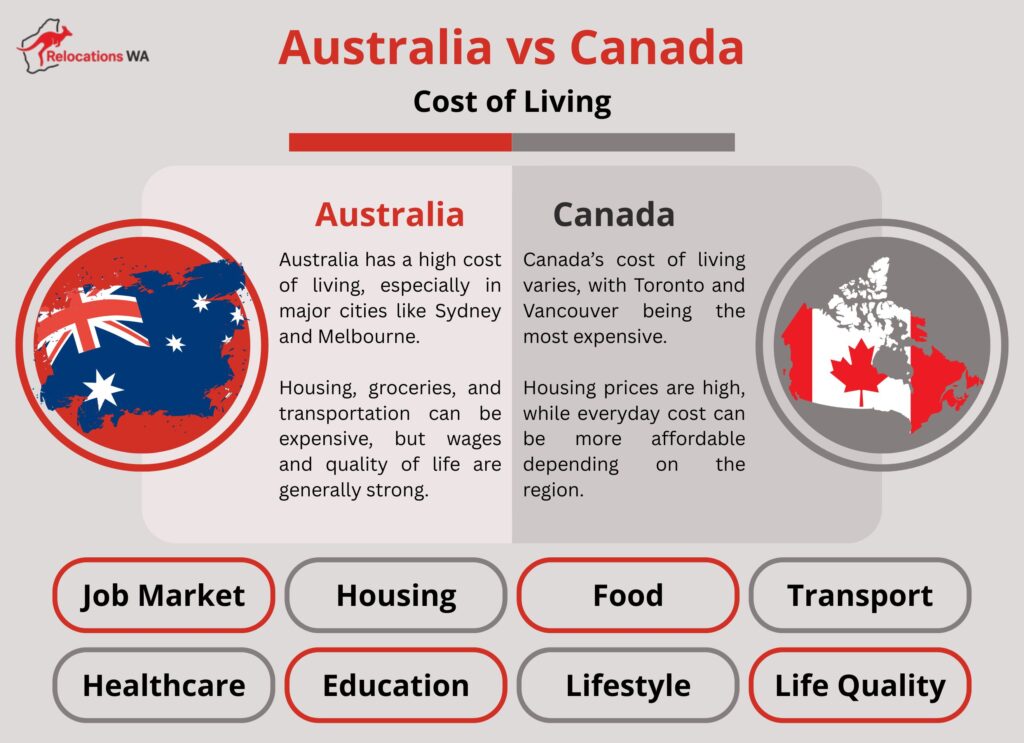
Australia Versus Canada: Reasons to Move
Australians move to Canada for a mix of practical and lifestyle reasons, and in our experience, it’s rarely a snap decision. Most clients have been planning their move for years, often after visiting or spending time studying or working in Canada.
Here are some key reasons why some people move to Canada:
- Housing affordability: This applies in particular to places outside Canada’s largest cities. While Sydney and Melbourne property prices continue to stretch household budgets, many Canadian cities offer larger homes at more accessible price points. Even in popular destinations like Calgary, Edmonton, or parts of Ontario outside of Toronto, buyers often get more space for their money.
- Career mobility: Canada actively attracts skilled migrants, and Australians often find their qualifications recognised with fewer barriers. Sectors like engineering, healthcare, construction management, IT, and trades tend to offer clearer pathways to employment and permanent residency compared to other overseas destinations.
- Family-focused social system: Parental leave policies, childcare subsidies in some provinces, and public healthcare in Canada can make long-term planning feel more predictable. For Australians starting families or relocating with young children, this stability matters.
Climate can be another consideration, especially for those drawn to winter sports or seasonal work. Unlike Australia, Canada offers true seasonal variation, which appeals to people looking for a different pace of life.
From a removalist’s standpoint, many Australians aren’t leaving because Australia lacks opportunity. They’re moving because Canada offers a different balance that may suit them at a certain stage of life, as well as their career goals and long-term finances.
Economic Overview
When comparing Australia and Canada economically, the headline figures can look similar, but the lived experience often feels different once you factor in currency, everyday pricing, and regional variation.
| Category | Australia | Canada |
|---|---|---|
| Minimum wage (hourly) | AUD 24.95 (national) | CAD 15.00-17.85 (~AUD 16.35-19.46); federal CAD 17.75 (~AUD 19.37) – varies by province |
| Inflation rate (annual, Dec 2025) | 3.8% | 2.4% |
| Currency trend (CAD to AUD, 2025 average) | N/A | 1.09 |
- Inflation: Australia’s cost of living has risen sharply in recent years, particularly in housing, insurance, utilities, and groceries. Wage growth hasn’t always kept pace. This has, understandably, tightened household budgets, especially in major cities. Canada has faced similar inflation pressures, but price increases vary more widely by province.
- Purchasing power: Even as average salaries in Australia appear higher on paper, many expenses, such as rent, transport, childcare, and private health cover, consume a larger share of one’s income. In parts of Canada, especially outside Vancouver and Toronto, households often retain more disposable income after fixed costs.
- Currency conversion: This factor plays a key role for Australians arriving with savings. The Australian dollar has historically converted favourably against the Canadian dollar at various points, so this can soften initial setup costs.
From our international removals experience involving both countries, Canada tends to reward careful location choices. Australians who research provinces rather than focusing only on major cities usually find the economic adjustment smoother and more sustainable.

The Australia and Canada Job Markets
Employment conditions are often the deciding factor when Australians commit to a move to Canada. Both countries have strong labour markets; however, the structure and opportunities differ in ways that matter.
So, in considering Canada vs Australia living costs, make sure you factor these in:
- Income tax and compulsory costs: Australia generally offers higher base wages in sectors like mining, construction, and certain trades. However, income tax and compulsory costs, including superannuation contributions, private health cover, and housing, can reduce take-home pay. In Canada, salaries may be slightly lower in some fields, but tax systems are balanced by public healthcare and regionally adjusted living costs.
- Regional specialisation: The Canadian job market is more regionally specialised compared to Australia’s. Provinces actively recruit workers based on local shortages. This creates opportunities for migrants willing to live outside the largest metro areas. Engineers, healthcare professionals, software developers, project managers, and skilled trades are consistently in demand, particularly in Alberta, British Columbia, and Atlantic Canada.
- Career mobility: Australians often find that Canadian employers place great value on international experience, especially from comparable countries. This can shorten the time it takes to secure senior roles or transition industries.
Remote and hybrid work in Canada has also expanded options, so Australians can potentially earn metropolitan-level salaries while living in more affordable regions. From a relocation perspective, this has changed where people ship their belongings; not just to Toronto or Vancouver, but to smaller cities with better cost-to-income ratios.

Housing and Accommodation
Housing is among the first cost comparison clients want clarity on, and for good reason. Accommodation can significantly impact your budget. Realistically speaking, both Australia and Canada are dealing with housing pressure; still, affordability in Canada is often more flexible when you factor in location.
| Category | Australia | Canada |
|---|---|---|
| Rent | 1BR apt., AUD 1,490 (city centre); AUD 1,089 (suburbs) | 1BR apt., AUD 1,288 (CAD 1,181 – city centre); AUD 1,108 (CAD 1,016 – suburbs) |
| Mortgage | 6.41% (variable avg.); fixed from 5.19% | 3.84%-4.19% (5-year fixed, insured); variable ~3.35% |
| Electricity (monthly, 85m² apt.) | AUD 180-250 | AUD 120-200 (CAD 110-184); higher in winter |
| Water/sewer (monthly) | AUD 50-80 | AUD 60-90 (CAD 55-83) |
| Internet (60+ Mbps unlimited) | AUD 81.73 | AUD 58-65 (CAD 53-60) |
| Home ownership rate | 67% (2025); down from 70% | 68.5% (2025); stable despite urban pressures |
| Housing affordability index | 4.8 years median income for house (Sydney 12+ years) | 5.2 years median income (Toronto 10+ years); better in prairie regions |
Important Note: All figures quoted in our tables are averages and apply only at the time of writing.
In Australia, median house prices in cities like Sydney and Melbourne regularly exceed AUD 900,000, with inner and middle-ring suburbs pushing well past that. Weekly rents for a standard two-bedroom unit typically sit between AUD 650 and 850 (or higher, especially in Sydney) in these markets.
Canada’s major cities aren’t cheap either, but the spread between capital cities and secondary centres is wider. Toronto and Vancouver remain expensive, with average house prices often above CAD 1 million, but cities such as Calgary, Edmonton, Winnipeg, and Halifax offer far more accessible entry points.
Mortgage costs follow a similar pattern. Canadian home buyers generally face lower purchase prices outside the biggest cities, though interest rates are comparable to Australia’s. Property taxes in Canada are higher than council rates back home, but stamp duty equivalents are often lower, easing upfront costs.
Utilities tend to balance out, although costs change based on usage and location. Heating costs rise in winter, but electricity prices are often lower in Canada than in Australia.

Food and Groceries
Food costs are one of those everyday expenses that quietly shape how affordable a country feels once you settle in. Based on feedback from relocating families, groceries in Canada are broadly comparable to Australia, with some clear winners and losers depending on which specific items you buy.
| Category | Australia | Canada |
|---|---|---|
| Average grocery basket (staples: bread, milk, eggs, rice, chicken, produce for a family of 4, monthly) | AUD 500-650 | AUD 450-550 (CAD 413-504) |
| Cost examples (1kg per item) | Bread (AUD 2.26), eggs (1 dozen, AUD 5), apples (AUD 3.26), potatoes (AUD 2.53), chicken breast (AUD 8.81) | Bread (AUD 2.67, CAD 2.45), eggs (1 dozen, AUD 3.72, CAD 3.41), apples (AUD 4.26, CAD 3.91), potatoes (AUD 2.65, CAD 2.43), chicken breast (AUD 12.97, CAD 11.90) |
| Dining out (2 people, mid-range 3-course meal) | AUD 140 | AUD 120 (CAD 110; 10.7% less) |
| Local produce vs imported | Local cheaper (e.g. apples AUD 3.26/kg, bananas 2.85); imported +20-50% | Local favoured (bananas CAD 1.41/kg, potatoes 2.43); imported meats/produce +15-40% |
| Regional food cost differences | Sydney/Melbourne +15% vs regional (NT/Tasmania pricier sans Aldi) | Toronto/Vancouver +20% vs prairies (Atlantic provinces highest at +5-10% national average) |
Important Note: All figures quoted in our tables are averages and apply only at the time of writing.
Meat pricing is more mixed, as in the case of beef, which can swing either way. Premium cuts are expensive in both countries, but everyday mince and stewing beef often costs less. Fish is generally more affordable in coastal Australian cities, while inland Canadian centres rely more heavily on frozen or imported seafood.
Fresh produce reflects climate and distance. Potatoes, carrots, apples, and corn are inexpensive in either country when in season, though Australia’s year-round growing conditions keep vegetable prices steadier.

Transportation and Mobility
Transportation costs vary widely in both countries, but Canada and Australia take different approaches to mobility. The biggest difference is how essential a car becomes once you choose where to live.
In major Canadian cities like Toronto, Vancouver, and Montreal, public transport is more developed than in most Australian cities. Monthly transit passes provide access to trains, trams, and buses that cover large urban areas. Outside those centres, car ownership becomes almost essential, similar to suburban Australia.
| Category | Australia | Canada |
|---|---|---|
| Annual car ownership cost (avg. sedan, incl. fuel/ins/maint/reg) | AUD 8,200-9,000 (14.8% of income) | AUD 5,500-6,000 (CAD 5,045-5,505) |
| Fuel (1 L unleaded) | AUD 1.85 | AUD 1.68 (1.54 CAD) |
| Car insurance (annual, comprehensive) | AUD 1,340-1,850 | AUD 1,200-1,600 (CAD 1,101-1,468) |
| Maintenance/servicing (annual) | AUD 1,567 (higher in some places like Canberra) | AUD 1,000-1,400 (CAD 917-1,284) |
| Public transport (monthly pass) | AUD 142 | AUD 124 (CAD 114) |
| Ride share (avg. 10km urban, e.g. UberX) | AUD 25-35 | AUD 22-30 (CAD 20-28) |
| Domestic airfare (return, 500-800km, e.g., Sydney-Melbourne or Toronto-Montreal) | AUD 150-250 | AUD 130-220 (CAD 119-202) |
| Long-distance land travel (e.g., train/bus 500km return) | AUD 120-200 (e.g., Sydney-Brisbane bus) | AUD 100-180 (CAD 92-165; taking VIA Rail is pricier) |
Important Note: All figures quoted in our tables are averages and apply only at the time of writing.
Owning a car in Canada is often cheaper overall, although maintenance costs can rise due to winter driving conditions, including snow tyres, servicing, and corrosion protection. That said, long-distance road travel is cheaper in Canada, while the cost of domestic flights in both countries is comparable, especially between smaller cities.

Healthcare and Insurance
Healthcare is one of the clearest structural differences Australians notice after moving to Canada. Both countries provide publicly funded healthcare, but the way costs show up in household budgets differs.
Canada operates a universal healthcare system administered by individual provinces. Permanent residents and citizens receive coverage for doctor visits, hospital care, and essential medical services at no direct cost. There’s no Medicare levy equivalent deducted from wages, which surprises many Australians early on.
Australia’s Medicare system is similar in coverage. However, Australia’s healthcare system outperforms Canada’s overall, as it combines universal public coverage with private options for better access, shorter wait times, and more favourable outcomes at a lower cost.
In Canada, private insurance is commonly used to cover services not included in public plans, such as dental, vision, physiotherapy, and prescription medication. Employer-provided health insurance is widespread and often generous, reducing out-of-pocket expenses for working families.
Prescription drugs are notably more expensive in Canada without insurance, though government programs assist seniors and low-income residents. Australia’s Pharmaceutical Benefits Scheme (PBS) keeps medication costs more predictable overall.

Childcare and Education
For Australians relocating with children, education and childcare costs are often a deciding factor.
Childcare in Australia is among the most expensive in the OECD, even after government subsidies. Full-time daycare in major cities can easily exceed AUD 120–160 per day before rebates.
Canada used to sit in a similar bracket, but that’s changing. Several provinces, including Ontario, British Columbia, and Alberta, have introduced capped or reduced-fee childcare programs. Many families now pay closer to CAD 10–20 per day for licensed care, depending on availability and location. Access can be competitive, but the cost difference is significant once secured.
| Category | Australia | Canada |
|---|---|---|
| Public schooling (K-12, annual per child) | Free for residents (public); no fees post-enrollment | Free (public); minor levies CAD 100-500 (~AUD 109-545) in some provinces |
| Private schooling (K-12, annual avg.) | AUD 10,000-25,000 (15-20% enrollment) | AUD 12,000-28,000 (CAD 11,000-25,700; 7-10% enrollment) |
| University tuition (domestic undergrad, annual) | AUD 4,000-15,000 (subsidized via HECS-HELP loans) | AUD 7,700-13,000 (CAD 7,000-12,000); varies by province |
| Student loans | HECS-HELP (govt-guaranteed, income-contingent repayment at 1-10%; no interest beyond indexation) | Provincial loans/grants + Canada student loans (interest post-graduation prime+1%; income-based but stricter terms) |
| Childcare (centre-based, full-time, monthly) | AUD 1,786; Child Care Subsidy caps 85% for low/mid-income | AUD 830-1,200 (CAD 761-1,100, with a daily cap in some provinces |
| Family support programs | Child Care Subsidy (up to 90%), Family tax benefit Pt A/B (~AUD 5K/child/year), paid parental leave 22 weeks | Canada Child Benefit (non-taxable ~AUD 7K/child/year), Quebec Family Allowance; parental leave 12-18 months EI-paid |
Important Note: All figures quoted in our tables are averages and apply only at the time of writing.
Public schooling in both countries is strong and well-funded. Canadian public schools are free and generally well-resourced, with quality varying more by province and district than by postcode. Private schooling exists but is far less common than in Australia, where private and independent schools are often seen as the default option. As a result, many Australian families moving to Canada avoid private school fees altogether.
University costs are another contrast. Canadian domestic tuition fees can sometimes be lower than Australian university fees, particularly for undergraduate degrees. Permanent residents benefit from subsidised rates, and student loan systems in Canada tend to offer income-based repayment options similar to HECS but with lower average debt levels.

Lifestyle and Entertainment
Lifestyle costs are where many Australians expect Canada to feel cheaper. In everyday spending, that’s often true, with a few trade-offs.
| Category | Australia | Canada |
|---|---|---|
| Fitness/gym membership (monthly, mid-range) | AUD 47-85 | AUD 39-65 (CAD 36-60) |
| Sports/recreation (e.g., soccer team annual, tennis court hourly) | AUD 200-400/year per team; AUD 25/hour court | AUD 150-350/year (CAD 138-321); AUD 20/hour (CAD 18.94) |
| Dining out (mid-range meal for 2, 3 courses) | AUD 140 | AUD 120 (CAD 110) |
| Coffee culture (cappuccino + pastry) | AUD 8-12 daily (e.g., AUD 5.46 for coffee) | AUD 6-10 (CAD 5.50-9.20; Timbits deals) |
| Nightlife (cocktail/pub round for 2) | AUD 35-50 | AUD 25-40 (CAD 23-37) |
| Streaming/subscriptions (Netflix Standard + Spotify) | AUD 28-32/month | AUD 22-28/month (CAD 20-26) |
Important Note: All figures quoted in our tables are averages and apply only at the time of writing.
Gym memberships in Canada are often priced lower than in comparable facilities in Australia’s capital cities. Dining out varies by city, but casual meals and mid-range restaurants tend to cost less in Canada, including café breakfasts, which are more affordable than Australia’s brunch-heavy culture. Canada’s coffee scene is more functional than ritual-based, and espresso quality can be a hit or miss compared to Australia. Streaming services, phone plans, and subscriptions are broadly similar in price.
Overall, everyday entertainment often stretches further in Canada, just without Australia’s café obsession.

Quality of Life
Quality of life is harder to quantify, especially since both countries are desirable places to live.
Work-life balance in Canada is solid, though annual leave entitlements are usually lower than in Australia. Commute times depend heavily on city choice. Toronto and Vancouver experience congestion similar to Sydney, Perth, and Melbourne, while people living in mid-sized cities experience noticeably shorter travel times and less daily friction.
Safety and cleanliness are exemplary in both countries. Climate is the biggest lifestyle adjustment. Canadian winters are long and cold, and can massively affect daily routines and outdoor habits. That said, cities are built for it, with indoor heating, snow clearance, and winter infrastructure that are efficient.
Health outcomes are comparable in both countries because of walkable cities and ample outdoor recreation. For Australians who enjoy structure, seasonal living, and predictable services, Canada often feels calmer and less rushed.
Does Moving to Canada From Australia Make Sense?
From a relocation professional’s perspective, the move makes sense for Australians who value long-term stability over short-term earnings. Canada often offers more affordable housing options outside major cities, lower childcare costs, and reliable public services that reduce household expenses over time.
That said, a move from Australia to Canada is not a universal upgrade. Salaries can be lower in some industries, winters are demanding, and alcohol, mobile services, and domestic flights cost more. Australians who thrive on warm weather, coastal living, and high disposable incomes may find the adjustment to Canadian life challenging.
Hopefully, with this extensive guide comparing Australia’s cost of living vs Canada’s, you’ll be in a better position to make the right decision.
Choose Relocations WA for Your Australia to Canada Move
Moving between Australia and Canada isn’t just about the distance. Planning, proper timing, and knowing what actually matters all matter. As specialists in overseas relocations, we don’t deal in guesswork or provide generic advice.
For Australians ready to make the move, working with experienced international removalists to Canada from Australia can help simplify packing, overseas shipping, customs requirements and delivery to your new home.
From providing realistic international removals costs to assisting with customs requirements, shipment planning, and city-specific insights, we help clients avoid unnecessary stress.
If you’re weighing up life in Canada or need a detailed overseas moving checklist, having an experienced removalist on your side makes the difference between a smooth transition and a costly learning curve.
Relocations WA is here to make your move practical, informed, and properly planned.
Get your moving quote today!
Moving house?
You might also like

Richest Suburbs in Perth: Where Interstate Movers Find Premium Living
We often speak with families, professionals, and downsizers who are moving to Perth because they want more than a new address. They want space, better lifestyle balance, beautiful beaches, access to the Swan…

Worst Suburbs in Melbourne: What You Should Know Before Relocating
Melbourne is one of Australia’s most popular relocation destinations, and it is easy to see why. It has strong job opportunities, great food, major universities, family-friendly pockets, and plenty of lifestyle variety. But…

Best Suburbs in Melbourne: Finding the Right Melbourne Suburb for You
Melbourne stands out as one of the world’s most livable cities thanks to its strong healthcare system, high-quality education, vibrant culture, reliable infrastructure, and overall stability. It currently ranks as the top city…




