



Change Utilities When Moving: The Ultimate Checklist and Guide


Author | Steve Blackwell
 relocationswa.com/about/steve-blackwell
 linkedin.com/in/steve-blackwell
Before fully immersing yourself in the excitement of moving into a new place, taking care of some logistical tasks first, such as the change in utilities when moving, is important. Think of moving into new property utilities, redirecting mail, and getting your internet up and running. You’ll thank yourself for staying on top of these important details early on.
Don’t let concerns about managing home utilities during a move diminish your enthusiasm. While household tasks like setting up your internet or arranging for mail forwarding can feel like drudgery, they need not be daunting.
Whether you move intrastate, interstate, or internationally, gain the knowledge you need to make moving home a breeze with our comprehensive guide on disconnecting and connecting utilities. Discover the typical timeline of the process and gain insights into what you need to know about setting up utilities in the new house. Let us help you navigate the complexities of utilities during your big move.
When to Start the Process
Moving can feel like a whirlwind, but getting a head start on moving house utilities can smooth things out. Thinking about kicking off the official moving utilities process about 2 to 4 weeks before your moving day is a solid general guideline.
It allows you enough room for wiggle to take important steps such as connecting utilities before settlement or getting your household utilities in order, without being utterly rushed. Your existing service providers will typically require lead time to cut services in your previous setting and possibly establish in your new one.
Talking about your new location and connecting utilities when moving house is another puzzle. Be it getting the electricity on or ensuring your appliances are connected well, booking these appointments earlier will save you the frustrations of a time without home utilities.
Starting these kinds of house utility tasks a few weeks out will make you feel more in control and less stressed as moving day approaches.
Budgeting for Utility Changes
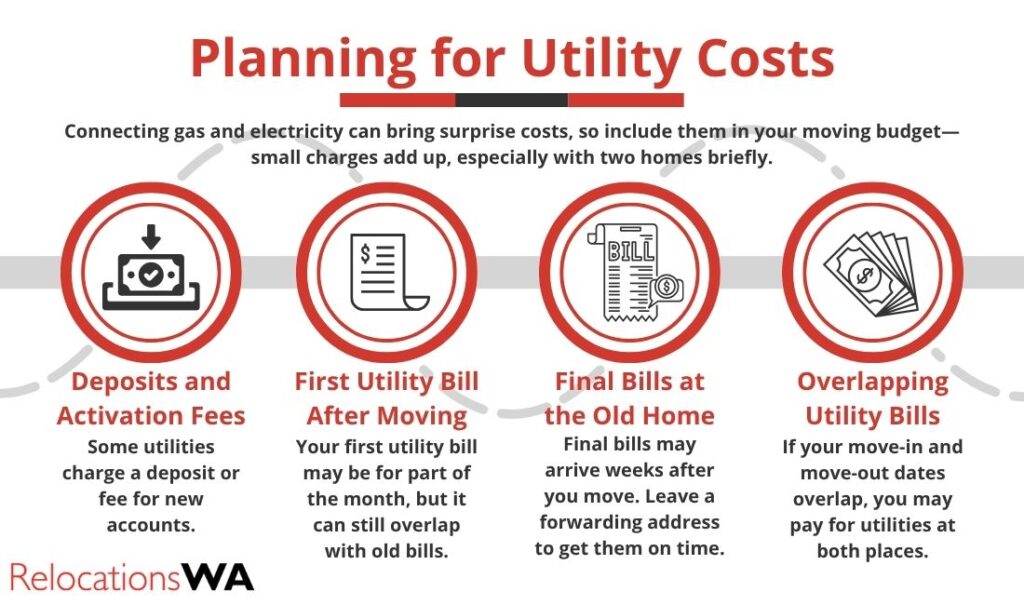
When connecting gas and electricity when moving home, there are often cost surprises, so it pays to plan and incorporate these charges in the budget for moving home utilities. Although these may not seem like a lot, several small charges can add up quickly if you are juggling utilities in two different places for a short period.
Deposits and Activation Fees
Several utility companies also ask for a security deposit or activation fee when opening a new account, especially if you’re a new customer or have no recent payment history in the region. That’s whether you’re setting up utilities when renting in Australia or buying a property. Others will not require deposits if you opt for autopay or give a credit reference.
Prorated First Bill at the New Home
Your first house utility bill at your new address will often be prorated based on the start date of your service and the billing cycle. While this means you won’t be charged for a full month, the partial bill can still overlap with final payments at your old home, so don’t assume your household utilities expenses will immediately go down after the move.
Final Bills at the Old Home
Remember that final bills can come a few weeks after you’re out. You need to leave a forwarding address for your providers so you get these on time, particularly for statements for gas and electric utilities when moving house.
Covering Two Locations Temporarily
You might have utilities at your old and new homes on for a short time, particularly when there’s some overlap between move-out and move-in dates. This means paying twice for bills in advance for a few days. Allocate funds on this budget to take care of this short-term, twice-billing. Advanced planning of your water connection and your electricity when moving house beforehand lowers confusion.
List of Utilities To Change When Moving House
Moving into new property utilities and knowing your utility responsibilities is important when moving into a new home or apartment when moving into new property utilities, even if they’re included in your monthly rent. Before settling into your snazzy new space, look at our helpful list of potential set-up utilities. Figuring out these initial details can save you much hassle in the long run. Let’s dive in!
Setting Up Your Electricity Account In Your New Home
When you’re moving into a new home, there are a lot of important tasks to check off your list, such as transferring your electricity. In Western Australia, Synergy is the main electricity provider, and they’ll take care of switching over your billing information. However, it’s crucial to reach out to them well ahead of your move-in date to guarantee your lights will work smoothly once you arrive.
The task of utilities to change when moving can feel overwhelming, but fear not! We have gathered all the information you need to streamline the process and easily get started. Let us help guide you through each step so that you can focus on enjoying your new space instead of stressing over the details.
We suggest giving at least three days’ notice before your big move to ensure a smoother transition.
You can get the ball rolling by calling or filling out their online form. No hassle, provide your moving details and send a copy of your bill, and you’re on your way to a stress-free relocation.
When you move out of your old home, Synergy ensures you’re well-charged for your energy consumption. They’ll contact Western Power and arrange for your metre to be read before a new account is assigned. As a result, the final bill you receive will only reflect what you’ve truly consumed, ensuring that you don’t pay for someone else’s usage.
Setting Up Your Gas Account In Your New Home
Don’t let the convenience of gas slip your mind when you move. Whether it’s powering your stove or heating your home, transferring your gas account to your new address is a breeze. Regardless of your retailer, the process is easy and stress-free. Keep the flames burning and ensure your showers stay cosy with a hassle-free transfer of your gas account.
Gas connection transfers may seem overwhelming, but it can be a breeze with a bit of preparation. To ensure a smooth transition, give your gas retailer at least 1 day’s notice before your desired connection transfer date.
You can easily initiate the process by logging into your account on the retailer’s website and following the user-friendly prompts. If you prefer a personal touch, don’t hesitate to call your retailer; they’ll happily guide you through the process over the phone.
When switching energy providers, it’s important to remember that tying up loose ends with your old provider is just as crucial as signing up with the new one. To ensure a smooth transition, connect with your previous provider and request a disconnect of services at your old home.
Setting Up Water In Your New Home
Owning a property means taking on the responsibility of paying for the water supplied to the address. When buying a property, you won’t have to worry about water being turned off since the water board usually doesn’t do that.
However, it’s important to note that you will be responsible for paying the bills. Your conveyancer will register your name with the council and ensure the seller pays their fair share until you become the legal owner.
Discuss any expenses related to the previous owners’ responsibility with your conveyancer, or reach out to your local council to inquire about the service as a whole. Don’t hesitate to seek clarification and make informed decisions about your new home’s water system.
Setting Up Internet In Your New Home
Imagine this scenario—you’ve just moved into your dream home, fully furnished, and you’ve even added some personal touches to make it Instagram-worthy. But, when you try to connect to your home internet, it states that there is no internet access.
Don’t let dealing with internet providers stress you out! While it may seem daunting, setting up your internet can be quite simple, thanks to the helpful support of most providers. Whether you’re a new or existing customer, you’ll find that most providers offer free online setup options to ensure that your internet is up and running smoothly.
Check Internet Availability
When picking a new home, don’t forget to consider the connectivity. You want to ensure your new address has solid access to fast broadband or NBN so you can stay connected without hiccups. While many parts of Australia are well connected, there are still some areas where the internet can be spotty.
Good news! With the nationwide roll-out of the NBN program, chances are high that your new home will have access to high-speed internet. However, if NBN hasn’t arrived at your new place, and you’re moving from a location with it, you may need to consider changing plans. Be sure to do your research! Find a provider with solid NBN upgrade plans to avoid unexpected cancellations or internet access loss.
Selectra Australia can help you find the best NBN plan deals. With their easy-to-use comparison tool, you can quickly compare providers and find the best plan for your needs.
Explore the possibility of a free upgrade from copper to the NBN with your internet service provider when it becomes accessible. It is worthwhile to inquire if your preferred provider can offer this service. Check the availability of the NBN at your new location.
Setting Up New Mailing Address In Your New Home
Don’t let bills and catalogues take over your mailbox during a move! Redirecting your mail is a crucial task that should be on your to-do list.
Moving to a new address can be hectic and stressful, but it’s important to remember to update your important accounts with your new information. Don’t risk missed bills or losing your credit card in the mail by forgetting to update your bank, health insurance, and superannuation.
Redirecting your mail has never been easier with Auspost. For as little as $32, you can ensure that your important letters and parcels are securely redirected to your new address. No need to stress about missing mail during your move. Simply visit the Auspost website and follow the easy steps to organise your redirection.
When To Connect Utilities When Buying a House
Make sure your new home is ready for the move-in day by planning for your electricity and gas connection. It’s important to arrange this at least 5 business days before your move-in date to ensure everything is set up and ready to go.
Keep in mind that weekends are usually not an option for energy connection, so don’t forget to plan accordingly.
Don’t sweat it if you’ve forgotten to set up your energy connection. You can still get it done on the same day or the next business day, as long as you call them within the right time frame of moving house. They will be on standby to get you hooked up and powered up in no time.
When moving to a new place, don’t forget to give your energy retailer a heads-up to disconnect your electricity and gas services. Believe it or not, you could still be charged for any usage after you leave. So take care of this important task beforehand, and you’ll receive a final energy bill from your current provider.
When transitioning to a new home, knowing the initial fees associated with your electricity and gas connections is important.
These fees are a one-time charge that will be included on your first billing statements for each utility. Considering these costs during moving can help you plan and budget accordingly.
Cost To Connect Electricity Bills To a New House & Other Utilities
Understanding the cost of utilities involves more than just paying your monthly bill. From initial connection fees to ongoing usage charges, being aware of all the expenses can help you budget and manage your expenses more effectively.
Connection Fees
Understanding the costs of setting up utility services can be tricky. Pricing for these services can vary greatly depending on the provider you choose.
For example, when it comes to the internet, there are often additional costs like purchasing a modem or paying a set-up fee for an installation technician. These fees can range anywhere from $70 to over $250. It’s important to research the options and associated costs to make an informed decision when selecting a provider.
When signing up for electricity, you may notice set-up utility fees involved, varying greatly depending on the provider. These fees can range from a reasonable $15 to a hefty $90. It’s important to be aware of these costs when considering different electricity providers, as they can impact your overall expenses.
Installing gas appliances in your home may seem like an expensive endeavour, but set-up costs can be as low as $10 to $50. The key is having a pre-existing gas connection. However, those without gas lines will incur higher installation fees.
You could strike gold and find a deal that doesn’t require any upfront expenses, granted you put in some effort to explore different options.
Ongoing Fees
Understanding your household’s utility usage can be challenging when it comes to budgeting for bills. The good news is that the size and location of your home, the number of residents, and the price of your plan are key factors that determine the cost.
Discover the scoops from consumer review and comparison site Canstar Blue. Their recent assessment and analysis pull back the curtain on some interesting findings worth checking out.
Electricity: The average annual prices range from $1012 in Victoria to $1444 in South Australia annually. This research, conducted in January 2021, provides valuable insights to help you plan your budget accordingly.
Gas: From the February 2021 research Canstar Blue uncovered the lowest quarterly bills in Western Australia at just $108, while Tasmania comes in at the highest average of $367. Stay informed about regional energy costs and how they affect your budget.
Water: Western Australian residents typically pay an average of $234 quarterly, while those in Tasmania can expect a bill closer to $365.
Moving Day Checklist
Let’s turn our focus to an essential moving checklist. Before you settle into your new space, make sure these critical systems are up and running smoothly.
Double-check that all utilities have been disconnected at your old home
Make sure to unplug everything before you say goodbye to your old digs! Safe moving means double-checking that all of your utilities have been properly disconnected. Don’t risk any mishaps or surprises down the line—take the extra few minutes to ensure everything is squared away before you load up the moving van.
Confirm that all utilities are connected and working at your new home
Ensure all utilities are hooked up and thriving. Double-check that gas, water, and electricity functions are operational. Also, ensure that the plumbing is working.
Run every faucet cylinder to examine the pressure of the water is sufficient. Ensure the lights switch when you flick them on and off around the house. Probe each outdoor outlet for power as well.
Keep essential utility documents and contact information handy
Assembling essential utility documents and contact information can give you greater comfort. It may come in handy if an emergency were to arise and you needed to access critical documents quickly.
Have your essential documents and contact information in one easily accessible spot! That way, your utilities won’t suffer during any urgent moments. Store the paperwork properly to make it in order and assurance when managing necessary utilities.
What To Consider After The Move?
Congratulations on your move—you won a hard-fought battle! Now that you’re at your destination, it’s time to celebrate. But before anything else, you’ll need to complete post-move considerations and ensure the transition process goes smoothly.
One important aspect is setting up online billing and account management. This can help save time when making monthly payments and ensure they will always be processed on time. After you set everything up, take a moment and review your first bills for accuracy. The potentially endless decisions made while moving can leave fingerprints everywhere. This step would ensure diligence has stayed put.
Finally, don’t forget to update your address with other relevant parties, such as banks and insurance companies. Getting it right immediately is key to ensuring minimal trouble when managing accounts.
You might also be interested in….
Tips For a Smoother Transition
Transitioning to a new service or utility provider doesn’t need to be stressful! Taking these few simple tips into account can help make the switch smoother:
- Start preparing for the transition as early as possible. This way, everything is ready when it’s time to switch.
- Keep detailed records of all our utility-related transactions, such as billing payments and services used before the changeover date. This will simplify navigating the transition process and verify that all expected payments have gone through effectively.
- Dedicate some time to researching discounts from different providers; many offer package deals that reduce costs and make budgeting easier.
- Don’t forget to inquire about potential energy-saving plans, programs, and other initiatives different providers offer. Ensuring we only pay for what users need and streamlining expenses in the process was never more accessible!
Utility Transfer for Renters
Setting up utilities when renting comes with a few extra steps, mainly due to the landlord’s role and what’s outlined in your lease. Before making any changes, be sure to:
Understand Your Landlord’s Responsibilities
Different landlords charge for the whole house utilities (water, gas, or trash) as part of the rent, but others let the tenant account for all utility costs. Before booking transfers or cancellations, it’s necessary to specify who is responsible for every service.
Know What’s Included vs. What You Handle
Check your lease or ask your landlord for a detailed list of which utilities are:
- Included in your rent (e.g., water, heat, trash)
- Your responsibility (e.g., electricity, internet)
Make sure you only cancel or transfer services that you manage. Accidentally disconnecting a landlord-covered service can cause complications, especially during moving—house electricity transitions.
Review Lease Clauses About Utilities
There are a number of rental agreements that outline how to set up utilities when renting or turning them off. For example:
- You may be forced to keep utilities active even after the lease comes to an end
- Some leases forbid a change of providers (internet/cable).
- You may be required to show that utilities were transferred to avert charges or penalties
Knowing about your lease can help you adhere to its requirements while preventing last-minute problems on your move-out.
Utility Transfer for Homeowners
For homeowners, the moving house gas and electric transfer process involves more responsibility and coordination.
Transferring Utilities
City-operated services, including water and trash collection, need a formal account closure or transfer. You’ll likely need to:
- Contact the city or local utility authority directly
- Give the closing date and details of the buyer
- Arrange a final reading on your meter (for water or gas).
Failing to do this can lead to continued billing, even after you’ve moved out.
Registering with Local Utility Authorities
As the buyer, you must open new accounts with municipal services in your name. This often involves:
- Filling out paperwork or applying online
- Showing proof of ownership (e.g., settlement statement)
- Paying any applicable connection fees or deposits
Plan to do this at least a week or two before move-in to avoid delays. If you’re wondering, “Do I need to connect water when I move?” Yes, especially for homeowners, a water connection is essential when moving house.
Title Company May Handle Final Water/Sewer Bills
In many home sales, the title company will pay the seller’s final water and sewer bills at closing. However, it’s still wise to follow up with your utility providers to:
- Verify account closure
- Confirm any refunds for overpayments
- Ensure there are no outstanding balances tied to your name
By staying proactive, homeowners don’t have to worry about untidy transfer of utility responsibilities, and prevent expensive blunders such as paying for duplicate electricity moving house fees.
Moving Internationally or Across State Lines
When moving to a different state—or especially another country—handling utilities becomes more complex. Utility services, providers, and regulations can vary widely by region, so it’s essential to do some homework before moving.
Utilities Work Differently Depending on Location
In some areas, services like electricity and water are handled by city-run departments. In others, they’re provided by private companies or cooperatives. This can affect what utilities you need to set up, how you set up service, what documentation is required, and how you’re billed.
Globally, the disparities are even wider – local utility norms, language, forms of payment, and even infrastructure might be foreign. Be sure you understand how stuff works so you do not get surprised.
Research Laws and Common Providers
Check local government websites, forums, or expat groups to find out:
- Which utility providers serve your new area
- What documentation is needed to open an account
- Whether there are tenant or homeowner obligations tied to utilities
- If certain utilities (like gas) are even available in the new location
Review the cancellation policies of your current suppliers. Some might ask you to give notice (e.g., weeks, months) or pay upfront costs, such as early disconnection fees, for services such as internet and electricity.
Consider Time Zone Differences When Scheduling
When moving across time zones—especially internationally—it’s easy to miss scheduled appointments or cutoffs. Make sure you’re accounting for time differences when:
- Booking electricity or water installations or disconnections
- Calling customer service
- Arranging final walkthroughs
Make calendar reminders and reconfirm all times to be on schedule. Ahead planning will help ease a smoother transition, regardless of how far you go.
Preventing Common Mistakes
Moving is stressful, and utility management is one area where small oversights can lead to big headaches. Here are some of the most common moving house utilities mistakes—and how to avoid them:
Forgetting to Cancel Auto-Payments
Failure to cancel or change automatic payments after moving leaves you open to paying for services you’re not using. Ensure you disable auto-pay after getting your final bill, or transfer it to your new account if you’re not switching providers.
Skipping Final Meter Readings
Always get a final meter reading—preferably with a time stamped photo—as proof of your last usage. This protects you from being billed for usage after you’ve moved out, especially when using gas and electric services when moving home.
Not Confirming Shutoff and Start Dates
It’s easy to assume everything is scheduled correctly, but errors happen. Always call or check online to confirm the exact dates your utilities will be disconnected and reconnected. This step alone can prevent moving house disasters like arriving at a dark or freezing house.
Check with your provider if you’re wondering if I need to be home for an electricity connection. In some cases, especially when moving house, someone must be present during installation.
Losing Account Access After You Move
After moving, you may no longer have access to the email or physical address linked to your utility accounts. Before you move:
- Update your contact info
- Set up online account access if you haven’t already
- Provide a forwarding address for final bills or deposit refunds
These small but crucial steps ensure nothing slips through the cracks during your household utilities transition.
Let’s Make Your Move Easy and Stress-Free
Changing utilities is an essential task when moving home. It ensures you can access essential services such as electricity, gas, water, and internet at your new place.
You must make necessary changes or arrangements to find yourself with access to these essential services, causing immense stress and hindering your day-to-day activities. Hence, it’s important to ensure that the transfer of utilities is set up before you move so that everything is in place when you arrive at your new home.
Imagine completing all your admin work beforehand and enjoying your new home. If you’re looking for even more convenience, why not let Relocations WA take care of all your moving needs? With professional expertise, you can sit back and relax while your move is handled with care.
At Relocations WA, we understand that relocating can be daunting as each move presents its unique challenges. But, with our years of experience, we have mastered the art of making every move hassle-free for you and your loved ones.
Frequently Asked Questions
Why is it important to change utilities when moving?
Utility management is crucial before you move house and it should be a part of your moving into a new house checklist. Overlooking this critical step may lead to double billing or the horror of living without power, internet, or gas for a few days. Don’t let these inconveniences become a part of your relocation story. Instead, plan out and take care of your utilities beforehand. It’s a simple task that will save you time, money, and headaches in the long run.
When should I start the process of changing utilities for my move?
Moving is a major undertaking that requires careful planning and preparation. To ensure a smooth transition, it’s recommended that you provide at least three days’ notice before your move.
How do I find out which utility providers service my new area?
Looking to connect with your local network operator and gain access to energy services in your area? Look no further than the Energy Network Association‘s nifty search tool. With just a few clicks and your postcode, you can easily locate the local network available in your area.
What steps should I take to disconnect utilities at my old home?
Step 1: Gathering Information
Make a list of utility accounts and gather account information. You need to ensure you are not violating any contracts before moving. Consider a transfer service before choosing the day for your disconnection.
Step 2: Closing Accounts
Contact each company for each utility. Return necessary equipment, such as, routers to close your account. Some companies may instruct you to leave some equipment behind. Afterward, you can request a final reading of your bills and forward them to your new address.
Step 3: Finish the Process
Complete your account setup by clearing remaining balances and discovering more about deposit options for your fresh accounts.
How can I ensure a smooth connection of utilities at my new home?
When it comes to moving, the last thing you want to worry about is connecting your utilities. That’s where connection services come in.
They work with various providers to ensure you have everything you need, from electricity and gas to telcos, insurance, and removalists.
All you have to do is give them your details, and they’ll take care of the rest, leaving you more time to focus on settling into your new home. Plus, with the added benefit of paying all your bills in one place, it’s an easy and efficient way to manage your expenses.
Are there any fees or deposits involved in setting up new utility accounts?
Yes. As a new customer, you’ll want to keep in mind that some utility companies may require additional financial measures as a safeguard against non-payment. In particular, you may need to put down a utility deposit or provide a letter of guarantee.
Your credit history can influence your deposit amount. Maintaining a good payment track record can lower or even eliminate the deposit requirement.
Can I transfer my existing utility accounts to my new home, or do I need to set up new accounts?
It’s possible. If the previous account holder has closed their account before your scheduled move-in day, you’re good to go.
And if the utilities you are signed in exist in your new place, you can keep your existing utility accounts. You can settle in and enjoy your new home without worrying about lingering connections to the past tenant.
How can I keep track of all the utility changes during my move?
Organise your move like a pro by setting up a utility folder. Keep all your monthly utility bills in one place and list the contact numbers for your current and future service providers.
Remember to jot down important appointment details in the folder to stay on top of everything. With this system, you’ll surely have a smooth transition in your new home.
What should I do if I encounter any issues with utility connections at my new home?
When setting up your utility connections, you may encounter some unexpected problems. Your utility provider can help. You can have your concerns investigated and addressed by reaching out to them.
Can I bundle utility services like internet and cable for convenience and potential savings?
Yes, you can. As technology advances, utilities are expanding their services to include internet access. By bundling these services together, customers can save money and enjoy the convenience of having all their utility needs met by one provider.
With the increasing availability of these bundled packages, it’s never been easier or more cost-effective to stay connected and on top of your utility bills.
What should I do if I notice an error on my first utility bills after moving?
Ensure the accuracy of your bills by reaching out to your service provider if you suspect any discrepancies.
Even if you suspect an error, paying a portion of your bill is smart. It prevents your debt from climbing while the issue is sorted out and demonstrates your willingness to tackle obligations head-on.
Moving house?
You might also like

Richest Suburbs in Perth: Where Interstate Movers Find Premium Living
We often speak with families, professionals, and downsizers who are moving to Perth because they want more than a new address. They want space, better lifestyle balance, beautiful beaches, access to the Swan…

Worst Suburbs in Melbourne: What You Should Know Before Relocating
Melbourne is one of Australia’s most popular relocation destinations, and it is easy to see why. It has strong job opportunities, great food, major universities, family-friendly pockets, and plenty of lifestyle variety. But…

Best Suburbs in Melbourne: Finding the Right Melbourne Suburb for You
Melbourne stands out as one of the world’s most livable cities thanks to its strong healthcare system, high-quality education, vibrant culture, reliable infrastructure, and overall stability. It currently ranks as the top city…




