





Worst Suburbs in Sydney: Safety, Crime & Insights


Author | Steve Blackwell
 relocationswa.com/about/steve-blackwell
 linkedin.com/in/steve-blackwell
What is really regarded as the worst is very much a matter of lifestyle choices, priorities, and expectations.
Once, a client asked me, “What is the worst suburb in Sydney?” I usually pause and explain: a suburb being listed doesn’t automatically make it a terrible place to live.
In many cases, the areas that are flagged as Sydney’s most dangerous suburbs just don’t suit the kind of work a person has, or the type of family that they have, and so on.
It is also worth noting that Sydney is evolving rapidly.
Places I relocated individuals to half a decade ago now might be redeveloped with new facilities, new homes, and a better security system.
I always tell movers who move to Sydney: data matters, but so do your personal priorities.
In this blog, I will dissect the meaning of ‘worst’ as applied to movers like you, providing information on safety, commuting, housing, schools, and local facilities so you can decide which suburb best fits your life.
Also check our Best Suburb in Sydney to Live in guide.
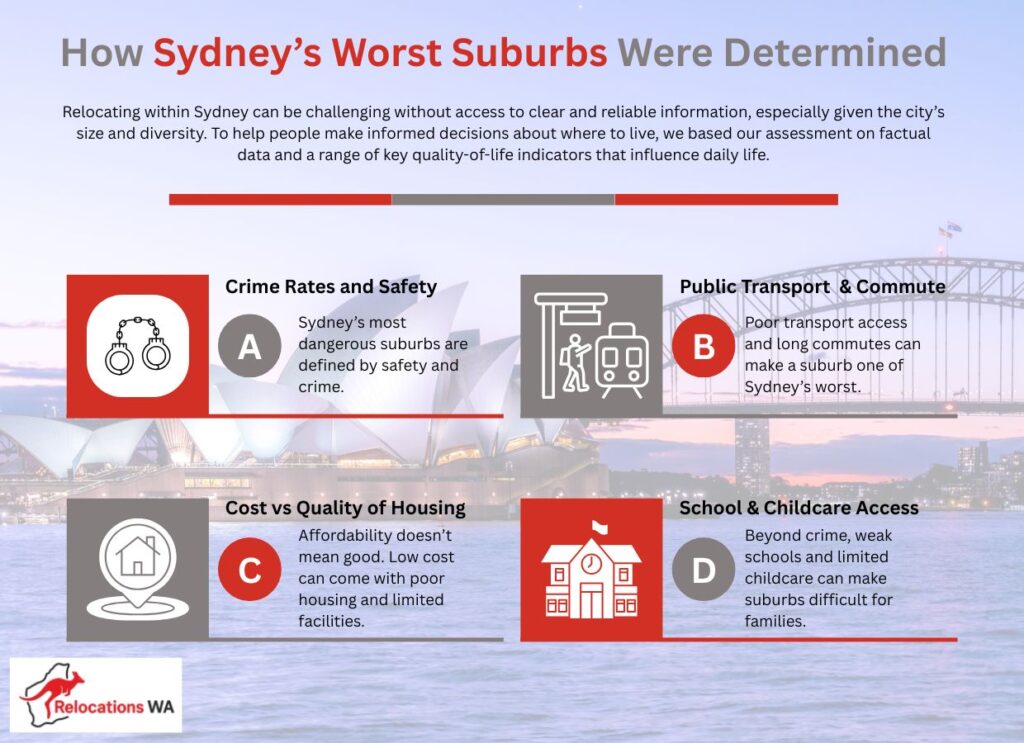
How We Defined the “Worst” Suburbs in Sydney
When people search for what is the worst suburb in Sydney, they tend to need actual, practical information.
To make a wiser choice before relocating, we derived our requirements from factual evidence and significant quality-of-life considerations.
Crime Rates and Safety Perception
When speaking about Sydney’s most dangerous suburbs, one is likely to focus on safety and crime.
We used aggregated crime statistics and ranked areas with higher-than-average crime rates.
For more detailed rankings of crime rates by suburb, check out this Crime Rankings list.
Public Transport Reliability and Commute Times
Time spent commuting and the quality of transport are important in a suburb that could be termed one of the worst places in Sydney, particularly for workers and students.
Even with low crime rates, it can be stressful to live in suburbs with limited access to frequent trains, buses, or ferries.
Most recent planning and access reports indicate that outer areas often have lower access to public transport and services, which impacts the everyday living of the population.
Cost vs Quality of Housing
Affordability alone doesn’t make a suburb good.
Although certain neighbourhoods might seem cheap, they might not be well-maintained, their housing might be of low quality, or they might lack facilities.
Many property and real estate guides that list areas to avoid in Sydney take this into account alongside crime and transport.
School Performance and Childcare Access
For families, the quality of schools and the accessibility of childcare are major factors in whether a suburb might be included among the worst suburbs in Sydney.
Although crime statistics are important, districts with overcrowded schools, limited early childhood services, or low school achievement can also be difficult for movers with children.
Worst Suburbs in Sydney (By Category)
Not all the worst suburbs in Sydney are bad for the same reason. Others are difficult because of the commute to the workplace, and others because of crime patterns in the community.
Worst for Long Commutes
Most of the suburbs appear cheap, but they take residents hours per week in commuting and rank among the worst places in Sydney for work-life balance.
Common issues:
- Infrequent train services
- Heavy reliance on buses or cars
- Long peak-hour congestion
- Limited access to major job hubs
Suburbs commonly affected by long commutes are:
- Mount Druitt – Mount Druitt residents often face long train journeys (often around 50+ minutes one way) or congested road travel during peak periods. While it has strong transport links, the long travel times and infrequent service make it a tough choice for daily CBD commuters.
- Airds – Public transport to central Sydney can take around 80–90 minutes, depending on transfers. With no train station in the suburb itself, many commutes involve buses and transfers.
- Claymore – A residential suburb in the Campbelltown area with limited local transport infrastructure. Commuters often rely on buses plus rail connections via neighbouring centres, which can result in multi-hour travel times, especially when transfers aren’t well coordinated.
- Bradbury – While this South-West Sydney suburb has access to public transport via nearby stations, it sits farther from major job hubs. Many residents commute into the city or regional centres, and peak congestion on arterial roads can extend travel durations.
- Ambarvale – Ambarvale’s public transport commute to the CBD is longer than that of the inner suburbs. Though it’s connected by rail at nearby stations, bus connections and timing can make peak-hour commutes slow.
These may still be workable for individuals who work in the area, locally or remotely, or at flexible hours.
However, for people who have to travel to the CBD or another major employment hub every day, the time spent travelling is a trade-off factor that may make or break a move.
Worst for Safety Concerns
When people search for the most dangerous suburbs in Sydney, they’re usually referring to areas with consistently higher reported crime, not isolated incidents.
Common crime types:
- Theft and break-ins
- Assault-related offences
- Property damage
- Drug-related incidents
Suburbs with consistently higher crime statistics are:
- Sydney CBD: The heart of Sydney records high crime rates relative to its population, partly due to the large number of visitors and nightlife activity. This often places the CBD near the top in crime rankings by suburb for Greater Sydney, even though many offences are non-violent and linked to high foot traffic rather than residential crime.
- Mount Druitt: Mount Druitt and its surrounding areas consistently rank among Western Sydney’s suburbs with higher total crime figures. Property offences, assault incidents, and drug-related reports are a notable part of the data.
- Blacktown: Blacktown has consistently high numbers of reported offences. Local data and media analysis also show Blacktown among areas with significant domestic and property crime, contributing to its appearance on lists of suburbs with elevated crime.
- Liverpool: It regularly appears in suburban crime rankings, with above-average recorded offences. Police operations and community safety initiatives are ongoing, but Liverpool still attracts attention in discussions about Sydney suburbs to avoid because of its relatively high crime rates.
- Bankstown: Bankstown ranks among the highest for theft and assault-related incidents compared with many other Sydney suburbs. While some crime categories have shown declines over recent years, the overall incident count remains higher than in many other areas, as reflected in crime rate rankings.
These are the suburbs commonly found on lists of Sydney’s highest-crime suburbs, though crime levels can vary greatly from street to street.
Worst for Families With Children
To families, a suburb can feel like one of the worst parts of Sydney due to poor services, not necessarily crime.
Common family challenges:
- Overcrowded or underperforming schools
- Limited childcare places
- Few parks or safe play areas
- Poor walkability and heavy traffic
Suburbs that families often struggle with:
- Airds: It has a higher crime rate than the NSW average and limited local services relative to its population, including school infrastructure. Capacity and choice for early learning options are more limited than in more central suburbs. These factors can make Airds feel like one of the worst areas in Sydney.
- Claymore: There’s relatively limited commercial infrastructure and play spaces compared with larger suburbs. These conditions can push Claymore to search for terms like “worst parts of Sydney” when families are considering suburb suitability.
- Mount Druitt: Studies have highlighted gaps in access to and quality of early learning. While there are many schools, families often juggle between accessing preferred schools and longer travel times to school. As a larger suburb, traffic and local congestion around school times can be significant.
- Bidwill: Community groups cite a need for safer, well-designed parks and play areas that cater to children. Families may currently find fewer age-appropriate parks and recreation options. These local challenges can make families feel they’re living in the worst parts of Sydney, in terms of everyday activity spaces and community amenities.
- Tregear: The suburb has minimal retail and services of its own. While there are open spaces, walkability and frequent local destinations are limited compared with more centrally located suburbs.
These are the suburbs often discussed as bad places to raise children in Sydney.
Worst for Renters on a Budget
Other suburbs are dubbed the worst Sydney suburbs because low rents tend to conceal problems with long-term rentals.
Common rental issues:
- Poor building quality
- Delayed maintenance
- High tenant turnover
- Rising rents without service improvements
Suburbs where cheap rent often comes with trade-offs:
- Mount Druitt: The median rent is around $490 per week across various dwelling types. However, some properties are older and may show more wear and maintenance lag.
- Blacktown: Median rents are often more affordable than inner Sydney averages. Household rental median figures are often around $630 per week (for houses), and unit rents are typically around $580 per week. But quality can vary significantly.
- Auburn: Median unit rent figures in the 12 months were around $620 per week, and houses were around $700 per week. However, a significant portion of the housing stock consists of older apartments, and has slower or inconsistent maintenance compared with newly developed areas.
- Lakemba: Lists of the cheapest suburbs to rent in Sydney often include Lakemba, which is seen as offering value relative to its distance from the CBD. The trade-offs here include older building stock and often higher tenant turnover.
Worst for Students and Young Professionals
Certain suburbs are easy to pick as convenient, but they can feel too isolating, and these are the worst places in Sydney for young people.
Common Issues:
- Weak nightlife and social options
- Poor late-night public transport
- Long travel times to universities
- Hidden costs of commuting
Suburbs students and young professionals often regret
- Mount Druitt: While it has basic amenities, its entertainment and night-time options are limited compared to inner-city suburbs, and some community perceptions focus more on convenience than lifestyle.
- Penrith: Travel times to central Sydney or university campuses can be long. While Penrith has a growing local economy and an outdoor lifestyle, some young professionals find that cultural and nightlife options are limited compared to those in inner-Sydney hotspots.
- Campbelltown: With only one main rail line south toward the Sydney CBD and limited late-night transport, travelling for events or social life can involve extra time and cost.
- Liverpool: Shopping and basic amenities are strong, yet nightlife — bars, live music venues, late-night cafes — is less developed than in inner-city suburbs. Community feedback highlights that some areas can feel quiet or empty in the evenings, which isn’t ideal for young adults seeking a vibrant weekend social life.
- Blacktown: While recent growth has brought more bars and entertainment options to Western Sydney, many young people still travel to Parramatta or inner Sydney for a wider range of nightlife. Transport links exist, but late-night services can be less frequent.
Common Mistakes People Make When Choosing These Suburbs
Many people who end up living in Sydney’s worst suburbs didn’t choose them intentionally.
Instead, they made a few common mistakes that only became obvious after moving in when relocating interstate in Sydney.
Choosing Based on Rent Alone
Cost of living in Sydney is one of the highest in Australia and so, many opt to find a cheaper place to rent. Reduced rental rates are what attract people to such locations most of the time.
However, cheap rent can sometimes hide:
- Poor housing quality
- Ongoing maintenance issues
- Higher crime or antisocial behaviour
- Extra transport costs
Ignoring Peak-Hour Travel Times
Another significant error is checking commute time outside of peak hours. What may appear to be a manageable suburb during midday may suddenly become one of the worst areas in Sydney to live in during rush hour.
Long and unreliable commutes are a common reason people label these suburbs as the worst part of Sydney.
Not Visiting at Night or on Weekends
The atmosphere of a suburb may entirely change at night or on weekends. Individuals who do not come at different times of day may miss warning signs.
Assuming a Suburb’s Reputation Is Outdated — or Accurate
Others shun the suburbs just because of the image, while others believe the negative perception no longer exists. Both assumptions are prone to poor decisions.
- Some suburbs once considered among the worst suburbs in NSW have improved due to infrastructure investment.
- Others still appear in the worst suburbs in Sydney list searches because long-term issues haven’t been resolved.
How to Choose the Right Suburb for You When Moving to Sydney
It is simple to get overwhelmed by the lists of the worst suburbs in Sydney when you are moving.
However, the reality is that there is no single worst suburb in Sydney; rather, there are areas that are not suitable for your lifestyle, financial capabilities, and values.
Rather than posing the question of what is the worst suburb in Sydney, it will be much more helpful to consider what is going to work for you effectively in the long run.
Budget vs Commute Balance
The need to balance the cost of housing and the time required to travel is one of the most significant choices. Lower rent can quickly lose its appeal when there is hours-long daily commuting.
Many people have described their locality as one of the worst places in Sydney, not because of a lack of safety, but because of day-to-day fatigue.
Safety and Lifestyle Priorities
Different individuals have different views of safety. Others pay close attention to crime statistics, while others are more concerned about lighting, walking conditions, or the overall atmosphere.
Rather than being influenced by dangerous suburbs in Sydney opinions, review suburb-based crime rates and compare them with how safe the place is for you. This is how you plan your move interstate.
This strategy gives you more context than merely avoiding the suburbs listed as unsafe on the internet in Sydney.
Family vs Single Living Needs
Your life stage matters. What a single person considers to be a nice suburb may be frustrating to a family, and vice versa.
Places mentioned as bad suburbs in Sydney might not be as bad as temporary places to stay, though some have problems with schools, childcare accessibility, or traffic.
Ask yourself:
- Do you need schools, parks, and childcare nearby?
- Or are nightlife, transport, and work access more important?
Most of the suburbs spotted on the list of Sydney’s worst suburbs just do not suit certain ways of living.
Renting First Before Buying
In case of doubt, it is better to rent and avoid costly mistakes. Spending 6-12 months of your life living in a suburb provides you with an insight that you cannot obtain from doing only online research.
Choosing where to live in Sydney isn’t about avoiding a list of dangerous Sydney suburbs — it’s about choosing a suburb that aligns with your priorities.
Many locations identified as the worst on online sites can either be ruled out with the right research or a realistic trial period.
Do Your Homework Before You Move
During my years assisting people with their moves, I have learned that Sydney is a city of micro‑neighbourhoods.
What one considers the “worst suburb in Sydney” may be a stepping stone to another person. The trick is to do your homework before committing.
I always make the clients know, visit the houses, check the roads, and spend some time in that suburb.
Check local amenities, parks, schools, and commute routes.
Use online data, speak to locals, and if possible, try renting first.
At Relocations WA, we help movers just like you through these decisions. We ensure that your relocation process is well-informed and easy, from planning your move to the suburb to the actual move.
Willing to discover the appropriate suburb of Sydney to live in? Prepare your moving interstate checklist, call us, and leave the pain of moving to Relocations WA.
You can also check out our Worst Suburbs in Melbourne guide.
Moving house?
You might also like

Richest Suburbs in Perth: Where Interstate Movers Find Premium Living
We often speak with families, professionals, and downsizers who are moving to Perth because they want more than a new address. They want space, better lifestyle balance, beautiful beaches, access to the Swan…

Worst Suburbs in Melbourne: What You Should Know Before Relocating
Melbourne is one of Australia’s most popular relocation destinations, and it is easy to see why. It has strong job opportunities, great food, major universities, family-friendly pockets, and plenty of lifestyle variety. But…

Best Suburbs in Melbourne: Finding the Right Melbourne Suburb for You
Melbourne stands out as one of the world’s most livable cities thanks to its strong healthcare system, high-quality education, vibrant culture, reliable infrastructure, and overall stability. It currently ranks as the top city…




