





Cost of Living Australia vs USA – An In-Depth Comparison


Author | Steve Blackwell
 relocationswa.com/about/steve-blackwell
 linkedin.com/in/steve-blackwell
There’s always been a healthy curiosity between Australians and Americans about how life stacks up on the other side of the Pacific. For many Aussies, the idea of moving to the United States may be exciting: bigger cities, a fast-paced lifestyle, and a huge range of career opportunities. For Americans eyeing Australia, it’s often the lure of coastal living, universal healthcare, and laid-back culture that makes them want to live in the Land Down Under.
But before you continue daydreaming or planning your Australia to USA move, there are key questions that need answering: Which country is actually more affordable to live in? How does the cost of living in Australia compare with that of the United States? Would an international move from Australia to the USA be worth it in the long run?
To help you decide, we’ve prepared a guide that gets into the nitty-gritty of the cost of living in Australia and the USA. It gives you a clearer picture of how far you can stretch your dollar in each place.
As a company with years of experience in international removals, Relocations WA offers insights that can help you plan your move wisely and avoid any financial surprises once you get there.
Related: Cost of Living Australia vs Canada

Cost of Living: Australia vs USA – Which Country Is More Affordable?
Most Australians assume life in the USA is cheaper. On paper, that’s partly true. Groceries, fuel, and general consumer goods can cost less stateside. However, the picture changes dramatically when you factor in healthcare, housing, and education.
In Australia, everyday costs might seem higher upfront, but you often get better value for what you pay. Public healthcare covers a large portion of medical expenses, the average wage is higher, and essential services tend to be more consistent across cities.
In contrast, the US offers a wider price range. You can live very affordably in some states, but face high costs in others, like California or New York.
The difference in the cost of living in Australia vs the USA often boils down to one’s lifestyle and location. For example, a one-bedroom apartment in Sydney can cost as much as one in Los Angeles, but the cost of utilities and insurance might tilt the balance.
In sum, the USA can feel cheaper for day-to-day spending. However, Australia’s social systems and income stability often offset that. So, in considering a move from Australia to the USA, it’s not just about what things cost. You need to ascertain what you’ll get for your money. This guide (and the calculator wizard below) will help you see the numbers clearly before deciding which lifestyle (and country) suits your goals.
Australia vs USA Cost of Living Calculator Wizard
To make things easier, we’ve built a Cost of Living Calculator Wizard to help you compare expenses between Australia and the USA city by city.
This tool gives you a quick snapshot of how your expected monthly costs might change if you move. Just plug in details like where you live now, the US city you’re considering, your household size, lifestyle, neighbourhood type, housing situation, and other variables.
For example, you can compare Perth to Austin or Sydney to San Francisco and instantly see the difference in monthly costs. It’s simple, accurate, and tailored for Australians. It’s also perfect for anyone weighing up an overseas move.
Australia vs USA Cost of Living Wizard
Answer a few quick questions. We’ll estimate monthly costs and show the difference.
Your Personalised Comparison State
Australia
USA
Overview of Economic Context
When comparing two developed economies like Australia and the United States, the numbers tell an interesting story, especially when you look at purchasing power, inflation, and currency trends.
Purchasing Power
Australians generally enjoy higher minimum wages and more predictable income security. As of 2025, Australia’s minimum wage sits at AUD 24.95 per hour, while the US federal minimum wage remains at USD 7.25 (equivalent to approximately AUD 11.10). This means everyday Australians tend to have stronger buying power relative to their essential costs. However, the US dollar’s strength means imported goods (especially electronics, cars, and branded clothing) are often cheaper in America.
Inflation Rates
Both countries have battled inflation in the last few years. Australia saw consumer prices peak in 2022 before easing to more stable lows in 2024, continuing into 2025. The US followed a similar trend, with average inflation rates surging to 8.0% in 2022, dropping to around 2.9% by late 2024. This similarity means living costs have risen on both sides, but wage growth in Australia has generally outpaced inflation slightly better than in the US.
Currency Conversion Trends
The Australian dollar (AUD) typically trades between USD 0.65–0.70, meaning that Australian incomes convert to fewer US dollars. This is an important consideration for anyone moving overseas or transferring savings. For those earning in USD and spending in AUD, however, this can be an advantage. The exchange rate tends to benefit Americans visiting or relocating to Australia, but it can make living in the US more expensive for Australians earning AUD-based income.
Australia vs USA – Job Market and Employment Opportunities
One of the biggest questions Aussies ask before relocating to the States is: Will I earn more in America? The short answer is: it depends on your industry, experience, and where you settle.
Both countries have strong job markets, but their structures and salary systems differ. In the United States, wages vary dramatically between states and even cities. Australia, on the other hand, tends to have a narrower pay gap.
Aus vs USA Salary — Which Offers More in Terms of Average Earnings?
According to recent data, the average full-time Australian salary sits around AUD 100,000, or roughly USD 65,000 when converted. In the US, the average full-time salary (considering the pay gap between men and women) is closer to USD 60,000 (about AUD 92,000).
Tax Matters
So, will your take-home pay go further in the United States, after taxes? The answer to this question isn’t simple, so it helps to know some basic information about how taxation works in either country.
Australian income tax rates are progressive, and while living costs are high, many citizens enjoy strong social services. In the USA, federal income tax plus state tax (which varies by state) can significantly impact net income. Additionally, deductions, social security contributions (Medicare, Social Security), and local taxes must all be factored into your calculations.

Housing and Accommodation
Housing is one of the most defining cost differences between Australia and the USA. While both countries have experienced property booms in recent years, affordability varies greatly by city and region.
Here’s a comparison table of Australia and the United States for 2025 regarding average rent and mortgage costs, utility costs (electricity, water, internet), home ownership rates, and affordability index:
| Category | Australia (approximate amounts in AUD) | USA (approximate amounts in USD) |
|---|---|---|
| Average rent | Sydney: $3,135/month, Melbourne: $2,617/month | Median rent for 1-bedroom: $1,384/month, 3-bedroom: $2,681/month |
| Average mortgage cost | Avg. monthly mortgage repayment: $3,910-5,290 | Median monthly mortgage payment varies, affordability stretched; avg. income needed $86,611/year for median home |
| Electricity cost | $150-250/month (depending on usage/location) | $180-250/month |
| Water cost | Avg. sewer/water: $60-90 | $40-60/month for water, $60-90 for sewer (often bundled) |
| Internet cost | $60-100/month | $55-95/month |
| Home ownership rate | Around 67% (Australia overall) | Around 65% (US overall) |
| Housing affordability | High mortgage repayment share (50% of income), rising interest rates, housing prices stabilising/slightly declining | Median-priced home unaffordable for average wage; requires 16% more income than average US wage to afford mortgage |
In Australia, the median house price is around AUD 860,000, with Sydney and Melbourne topping the list of expensive markets. In contrast, the US median home price is about USD 410,000 (AUD 628,000). That might make the American dream of homeownership seem more achievable, but not everywhere. Cities like Los Angeles, San Francisco, and New York often outprice Sydney, while smaller cities such as Houston, Phoenix, or Nashville are far cheaper.
For renters, costs vary greatly. A one-bedroom apartment in a major American city, averaging USD 2,000/month (AUD 3,100), could cost AUD 2,800–3,200/month in Sydney or Melbourne.
Utility costs differ slightly, and this is usually because of usage and location.
Home ownership rates tell another story: about 67% of Australians own homes compared to 65% of Americans, but Australian buyers are burdened with higher property prices relative to income. The housing affordability index consistently ranks the US higher overall. Still, while US housing can be cheaper, it’s not universally so. Major metro areas can rival Sydney prices, and Australia’s stronger tenant protections and lower interest rate volatility add stability.

Food and Groceries
Food expenses are a major part of anyone’s monthly budget, and this is one area where Americans generally have the upper hand. Groceries and restaurant meals are cheaper overall in the US, thanks to large-scale farming, lower transport costs, and market competition.
| Category | Australia (AUD) | United States (USD) |
|---|---|---|
| Supermarket prices (average basket) | Around $87.64 total for common groceries like fruits, bread, meat | Around $100.95 total for similar grocery basket items |
| Dining out | Generally cheaper than US; casual meals around $15-25 | Restaurant prices about 13% higher on average than Australia |
| Local produce vs imported goods | Local produce like apples, potatoes, bread generally priced moderately; imported goods (e.g. imported beers) more expensive | Local produce cheaper in some cases; imported goods often less expensive than Australia |
| Cost examples (1kg items) | Apples $3.15, Beef $14.25, Lettuce $2.26 | Apples $5.29, Beef $16.01, Lettuce $2.18 |
| Regional food cost differences | Western Australia – notably more expensive for groceries in general; Victoria slightly cheaper than national average | Higher variability across US regions, but generally, urban areas more expensive; no single dominant trend like Australia |
In Australia, grocery prices are higher largely due to supply chain distances and import costs. Staples like milk, bread, and eggs tend to be cheaper in America, while fresh produce and seafood often cost more, except if you reside near coastal regions like California or Florida.
Dining out also differs, with Australia being a generally cheaper country for eating out. In the US, while casual dining can be cheaper in some places, you also need to remember that tipping is expected in the States, and this could add about 15–20% to your bill.
Imported goods tell a different story. Australia’s smaller market and higher import taxes can make global brands pricier, including cereals and soft drinks. However, Australia’s locally produced fruits, wines, and meats are often fresher and more sustainable.
Regional differences play a huge role in both countries. In the US, cities like San Francisco or New York have food prices comparable to Sydney, while places like Texas or Ohio are far cheaper. Likewise, in Australia, living in rural Queensland or South Australia will stretch your food budget much further than in Sydney.

Transport and Mobility
Both countries are sprawling, which means cars are still king. But transport costs can vary widely between Australia and the USA, as the following table shows:
| Category | Australia (AUD) | United States (USD) |
|---|---|---|
| Car ownership costs | Average annual total cost ~$23,300 including loan repayments | Average annual total cost generally lower (~$9,000-12,000) but varies by state and city |
| Fuel | Average weekly cost ~$95 ($4,854 per year), about $1.70-2.10 per litre | Average US fuel price around $3.20 per gallon (~$0.85 per litre), yearly average varies by state |
| Insurance | Comprehensive insurance ~$2,637 annually in capital cities | Average car insurance $1,100-1,500 annually, highly variable by state |
| Maintenance | Around $1,750 per year including servicing and tires | Average maintenance $1,000-1,200 yearly |
| Public transport pricing | Weekly passes $40-60 depending on state/city; good coverage in metro areas | Weekly passes $25-70 depending on city; coverage varies widely, major metros have good coverage |
| Ride share | Average ride $15-25; generally more expensive outside metro areas | Ride average $10-20; generally cheaper and more frequent availability |
| Airfare (domestic) | Average domestic flight $150-300 depending on distance | Average domestic flight $150-250; extensive low-cost carriers |
| Long-distance travel (bus/train) | Long-distance bus/train fares $100-250 depending on distance and class | Long-distance train/bus fares vary $50-200+; Amtrak service limited but extensive bus network |
Transportation is cheaper in the US overall, but Australia’s systems have a much wider coverage, are more predictable, safer, and more environmentally conscious.

Healthcare and Insurance
Here’s where the cost gap truly widens: healthcare. Australia’s public healthcare system, Medicare, offers residents universal coverage for most medical services. Doctor visits, hospital stays, and even some prescription drugs are subsidised. Private insurance is optional but common, offering faster access to specialists and extra services like dental and physio.
In contrast, the US healthcare system is largely private and insurance-based. Without coverage, even basic treatments can be extremely costly. Most Americans rely on employer-provided insurance, and out-of-pocket costs like copayments and deductibles can still run high.
Prescription medications also cost more in the US, sometimes double what you’d pay in Australia.
In Australia, you can see a GP and walk out with most of the bill covered. In the US, even insured patients often face unexpected charges. That’s why many Aussies moving to the US are urged to research healthcare plans early and factor them into relocation budgets.

Education and Childcare
When you’re planning a move from Australia to the USA (or vice versa) and you have children, the education and childcare costs can make a substantial difference. The table below provides a general view of what education and childcare look like in both countries.
| Category | Australia (all amounts in AUD) | USA (all amounts in USD) |
|---|---|---|
| Public vs private school costs | Public schools: minimal fees, voluntary contributions ~$200-500/year; Private schools: $8,000-35,000+ annually depending on state and level (primary vs secondary), with top schools in Sydney nearing $50,000+ per year | Public schools: free but may have fees for activities/supplies; Private schools: $10,000-50,000+ per year, varying widely by location and exclusivity |
| University tuition | Domestic students pay $6,000- 11,000/year under government loan scheme (HECS-HELP); loans are income-contingent and interest-free until income threshold. International students pay much higher | Public universities: $10,000-30,000/year for in-state; private universities much higher $30,000-60,000+/year; loans are not income-contingent and can accrue interest, leading to higher debt burdens |
| Student loans | HECS-HELP loans widely used; repayment based on income, no interest charged, thresholds start at ~$50,000 income/year | Federal student loans with fixed or variable interest rates; repayment plans vary but can lead to long-term debt stress; private loans more expensive |
| Childcare fees | Average childcare fees about $100-130 per day; government subsidies (CCR) reduce the effective cost for eligible families | Average costs $60-100/day varying widely; subsidies (Child Care Subsidy) available but coverage and affordability can be limited |
| Family support programs | Strong government support with Family Tax Benefits, parenting payments, paid parental leave schemes | Various support programs exist but less uniform; federal child tax credits, some state-specific programs, paid leave is limited and varies by employer |
So, if you have children and you’re comparing Australia vs the USA, map out all education and childcare costs, and not just the tuition. Relocating is easier when you know how much extra you’ll spend every year, so you can budget effectively and avoid major surprises.

Lifestyle and Entertainment
Now, let’s take a closer look at how you’ll spend your spare time (and money) if and when you do move to the United States. Lifestyle and entertainment costs can feel optional, but expenses can accumulate and affect how comfortable your life will be.
| Category | Australia (AUD) | United States (USD) |
|---|---|---|
| Fitness, gym memberships | Average gym membership $50-60/month; budget gyms $10-30; premium gyms $80-150. Fitness rebates up to $250/year available. | Average gym membership around $50-60/month; budget $20-30; premium can exceed $100; variety of boutique and large chains |
| Sports and recreation | Costs vary; community sports often affordable; private clubs more expensive; digital fitness subscriptions ~$19/month gaining popularity. | Community sports fees vary; private gyms and clubs vary widely; digital fitness growing with similar costs $15-30/month |
| Dining, coffee culture, nightlife | Casual meal $15-25; coffee around $4-5 per cup; nightlife drinks $10-15; cheaper outside major cities. | Casual meal $12-25; coffee $3-5, generally cheaper; nightlife drinks $7-12; urban areas more expensive nightlife |
| Streaming and subscriptions | Streaming services $10-20/month evenly spread; popular platforms include Netflix, Disney+; leisure spending growing | Similar streaming costs $10-20/month; additional subscriptions (sports, gaming) are common; leisure spending higher overall |
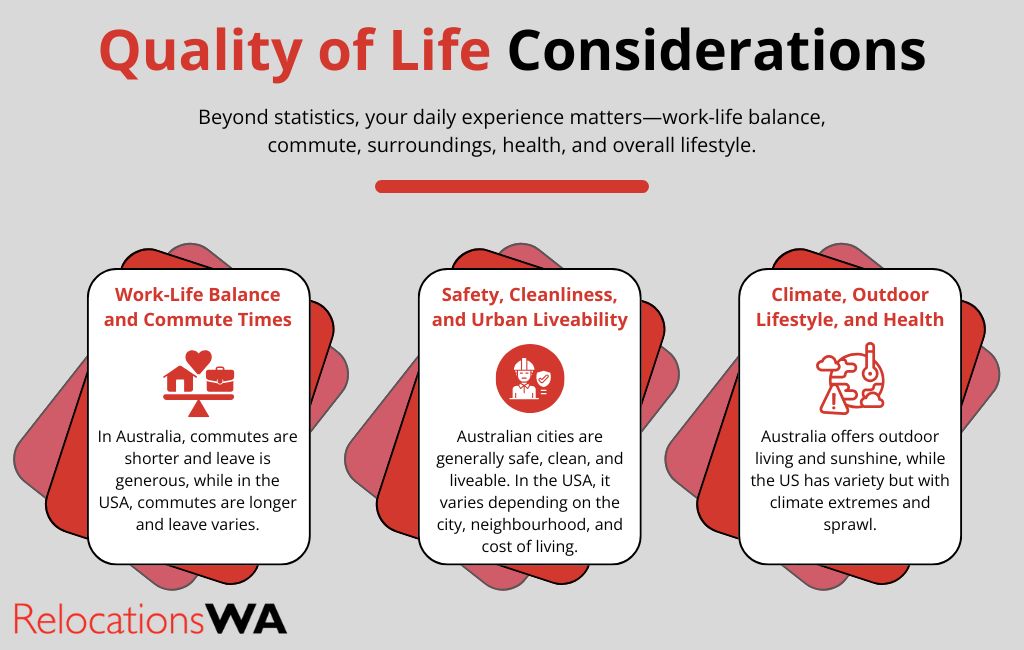
Quality of Life Considerations
Beyond the numbers, the lived experience of your location matters: work-life balance, commute times, environment, health, and the feel of everyday life.
- Work-life balance and commute times: In Australia, many regional areas or suburban locations offer shorter commute times (30 minutes or less) and stronger entitlements (annual leave, public holidays). In the USA, especially in large metropolitan areas, commutes can easily exceed 45 minutes to one hour each way, and paid leave policies vary widely (some employers provide very limited paid time off).
- Safety, cleanliness, and urban liveability: Australian cities often rank highly for safety, cleanliness, and liveability. Medium-sized cities (Adelaide, Perth, Brisbane) offer a good mix of amenities without the extreme costs or congestion of Sydney. In the US, many cities are very liveable, but you’ll need to pick carefully: safety and cost of living can vary dramatically between states or neighbourhoods.
- Climate, outdoor lifestyle, and health factors: If you enjoy outdoor living, i.e., beaches, bushwalks, summer weather, Australia arguably has the edge. That lifestyle can reduce stress, encourage exercise, and boost wellbeing. In the US, you get variety: warm climate states (Florida, Texas, Arizona) offer sunshine, while northern states offer different seasons. But climate extremes (hurricanes, winter storms) or urban sprawl may affect daily living.
If you’re moving to the USA or moving from the USA to Australia, ask yourself: How do the daily details feel? Because they matter just as much as your salary figure.
So, Does an Australia to USA Move Make Sense for You?
When you line up Australia and the USA side by side, you’ll find both offer compelling opportunities. However, they differ significantly in how costs, wages, and lifestyle stack up.
If you’re an Australian thinking of moving to the USA, you might earn more in some roles, but you’ll also carry higher costs and greater variation in quality of life depending on the state and city. Conversely, moving from the USA to Australia may mean slightly lower earnings in some jobs, but more predictable costs, shorter commutes, and a strong base for family life.
Relocations WA for Your Australia to USA Move (and Vice Versa)
Here at Relocations WA, we’ve handled dozens of Aussies relocating to the USA, and some reverse moves too. That means helping with the timing of shipments, navigating customs, understanding insurance for your belongings, and coordinating door-to-door delivery, whether you’re departing from Perth or arriving in Los Angeles.
So, for your Australia to USA move (and vice versa), make sure to get in touch with Relocations WA. We’re ready to help with the information you need on international removals prices and costs, and all other overseas relocation concerns.
We’ll do the heavy lifting so you can focus on your new chapter.
Moving house?
You might also like

Richest Suburbs in Perth: Where Interstate Movers Find Premium Living
We often speak with families, professionals, and downsizers who are moving to Perth because they want more than a new address. They want space, better lifestyle balance, beautiful beaches, access to the Swan…

Worst Suburbs in Melbourne: What You Should Know Before Relocating
Melbourne is one of Australia’s most popular relocation destinations, and it is easy to see why. It has strong job opportunities, great food, major universities, family-friendly pockets, and plenty of lifestyle variety. But…

Best Suburbs in Melbourne: Finding the Right Melbourne Suburb for You
Melbourne stands out as one of the world’s most livable cities thanks to its strong healthcare system, high-quality education, vibrant culture, reliable infrastructure, and overall stability. It currently ranks as the top city…




