



Worst Suburbs in Melbourne: What You Should Know Before Relocating

Author | Steve Blackwell
 relocationswa.com/about/steve-blackwell
 linkedin.com/in/steve-blackwell
Melbourne is one of Australia’s most popular relocation destinations, and it is easy to see why. It has strong job opportunities, great food, major universities, family-friendly pockets, and plenty of lifestyle variety.
But as interstate removalists, we also know that choosing the wrong suburb can make the move feel harder than it needs to be.
So, what are the worst suburbs in Melbourne? The honest answer is: it depends.
A suburb is not automatically terrible just because it appears in searches for Melbourne’s worst suburbs or suburbs to avoid in Melbourne.
Often, it simply means the area may come with trade-offs, such as long commutes, limited public transport, higher living costs, safety concerns, or a lifestyle that does not match your needs.
For anyone moving to Melbourne from another state, choosing a suburb can affect daily costs, commute times, and overall comfort.
At Relocations WA, we always suggest researching carefully before locking in a lease or buying a home.
What Makes a Melbourne Suburb “Worst” for Movers?
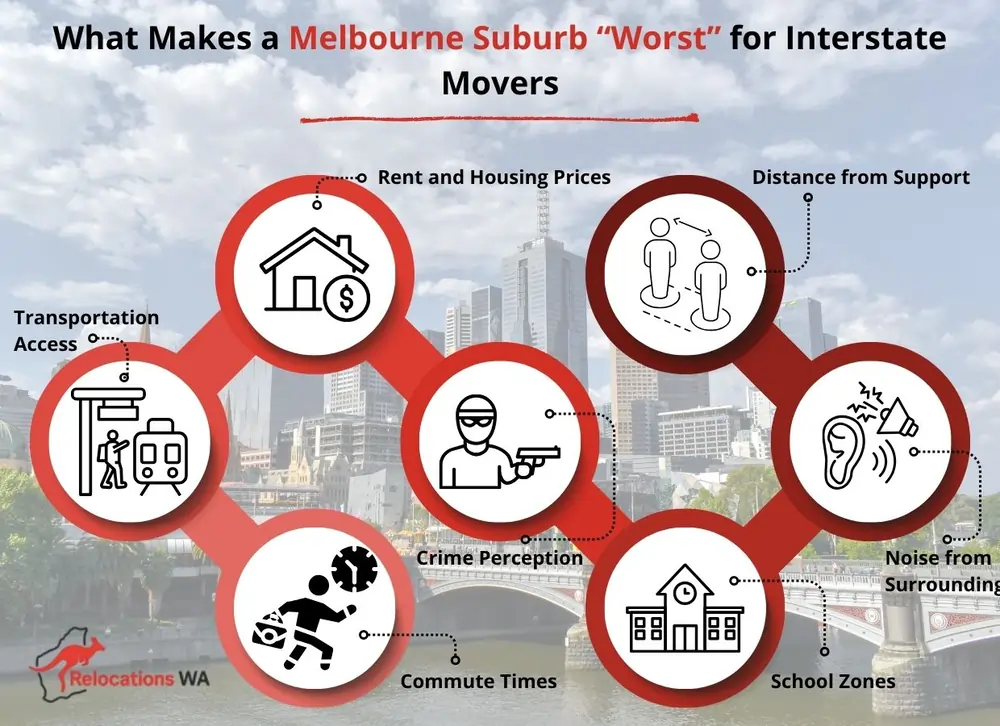
We don’t want to call any suburb “bad”. When we say the worst suburbs in Melbourne, we’re referring to suburbs that may present problems for some movers, depending on their job, finances, family status, and lifestyle.
Commute Time to Work or the CBD
For those moving from out of state, the worst suburb in Melbourne might be one that is too far from your workplace. A lower-cost rental may be less desirable if you are travelling for hours to the city, hospitals, universities, business parks, or trade sites.
We advise people to try out the commute during rush hour before deciding on the suburb. Transport Victoria’s official planner can be used to check public transport, road, walking, and cycling options in Victoria.
Access to Trains, Trams, Buses, and Major Roads
Some of the worst Melbourne suburbs for interstate movers are not always unpleasant or dangerous. They may just have limited transport options. A suburb lacking good train, tram, and bus connectivity may mean you have to rely on your car.
That means additional expenses for petrol, motorway tolls, parking, and vehicle wear and tear. That’s why we always recommend checking transport options before you rent or purchase a property.
Rental and Housing Affordability
A suburb may seem cheap at first, but remember: rent is only one of the expenses. You also have to consider other costs, such as bonds, utilities, transport, parking, insurance, and living expenses.
If you’re a renter, you can check rental rights, rental increase rules, and how to deal with excessive rental increases on the Consumer Affairs Victoria website.
Safety and Crime Perception
Many people search for the most dangerous, worst, or most unsafe suburbs in Melbourne before relocating.
That’s natural, but people’s viewpoints on the internet can be wrong, overblown, or biased.
Rather than relying just on lists of Melbourne’s most dangerous suburbs, we suggest looking at crime statistics.
The Crime Statistics Agency Victoria provides crime statistics based on recorded crimes, criminal incidents, alleged offender incidents, and victim reports.
School Zones and Family Suitability
The worst suburbs to live in Melbourne may be those that do not fit your school or childcare arrangements, park locations, community centres, or medical facilities.
It is better to assess school zones, conduct site visits, check the amenities, and determine whether the suburb meets your family’s needs.
Noise, Traffic, and Surrounding Areas
There are suburbs near industrial areas, airports, main roads, freight routes, or busy traffic highways. These suburbs are not necessarily on lists of suburbs to avoid in Melbourne, but they may not be ideal for new families seeking a quiet neighbourhood.
Here’s where a suburb tour is important. Check them out during the day, in the evening, and during rush hour.
Distance From Everyday Support
The worst suburbs of Melbourne may be those far from hospitals, shops, family, friends, schools, parks, or a support network.
When planning to move interstate, it’s important to look beyond just the rent and consider whether the suburb is right for your work, family, and personal interests. At Relocations WA, we always advise considering the suburb based on your lifestyle rather than the cheapest rent.
A Quick Melbourne Reality Check Before You Choose a Suburb
Before choosing where to live, it helps to look at Melbourne with fresh eyes.
We always advise people that a suburb can look attractive online, but not be at all affordable when you start looking at daily expenses, commute times, and access to services.
Melbourne can be cheaper than Sydney, but it’s not necessarily cheap.
Rent, utilities, transport, groceries, insurance, parking, and tolls can add up, particularly if you are relocating a family and/or have multiple cars.
Rent is still one of the biggest pressure points.
Melbourne’s median weekly rent in Domain’s March 2026 Rental Report is $590 for houses and $600 for units, with unit rents hitting a record.
On top of that, Australian Bureau of Statistics (ABS) figures confirm housing continues to be a major contributor to inflation, with the Housing group up by 7.2% over the year to February 2026, driven by electricity, new dwellings, and rents.
That’s why we recommend looking beyond just the weekly rent. Outer suburbs might appear cheaper to live in, but those savings can be offset by the cost of fuel, tolls, parking and public transport, not to mention the additional travel time.
Compare rent, transport, utilities, and groceries before you sign a lease, so you know what the true cost of living in Melbourne is.
For us at Relocations WA, the goal is not just to help you arrive in Melbourne. It is helping you plan a move that supports your lifestyle once you are actually there.
Worst Suburbs in Melbourne by Crime Rate
The “worst suburbs” in Melbourne are often the “worst suburbs in Melbourne for crime” or “dangerous suburbs in Melbourne”.
The crime rate varies by street, time of day, and property type, so people should always check the Crime Statistics Agency Victoria before they move.
CSA reports official statistics by area for offences and incidents, victim reports, and alleged offenders.
| Suburb | Crime Rate Snapshot* | Common Crime Types |
|---|---|---|
| Melbourne | 11,867 per 100k | Theft, assaults, car-related crime |
| Dandenong | 9,851 per 100k | Violent crime, motor vehicle theft |
| Broadmeadows | 2,114 per 100k | Break-ins, vehicle crime, violent crime |
| St Kilda | 7,489 per 100k | Break-ins, vehicle theft, assaults |
| Footscray | 7,038 per 100k | Vehicle theft, break-ins, violent crime |
| Collingwood | 2,035 per 100k | Break-ins, vehicle crimes |
| South Melbourne | 4,119 per 100k | Vehicle theft, break-ins |
| Southbank | 5,267 per 100k | Vehicle crime, assault |
| Carlton | 2,605 per 100k | Vehicle theft, break-ins |
| Richmond | 2,191 per 100k | Vehicle theft, break-ins |
*OpenStats reports annual rates per 100,000 people for 2022–24 using state police and ABS data.
Inner suburbs may have more incidents because they have nightlife, tourists, apartments, shops, and train stations. That doesn’t always make them the worst places in Melbourne, but it does mean buyers should take a long look.
High-Risk Suburbs in Melbourne
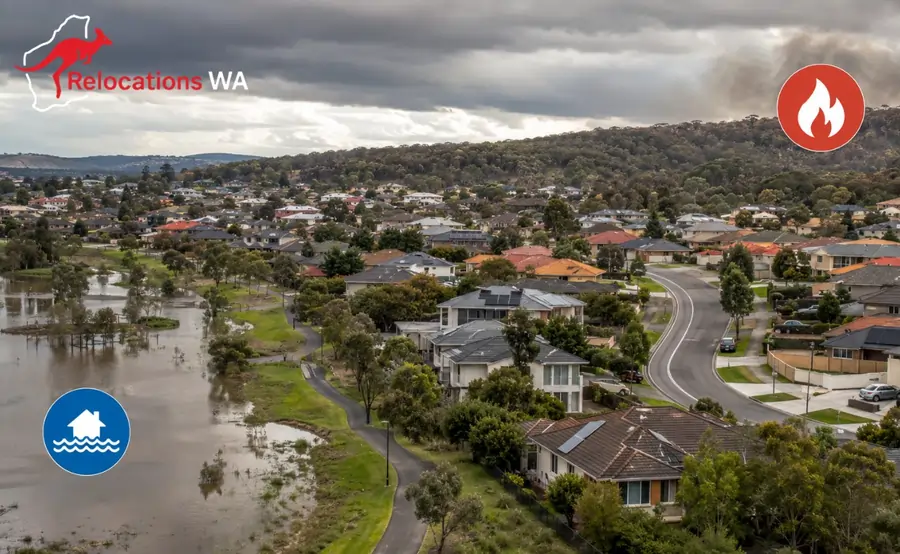
Some suburbs to avoid in Melbourne may not be unsafe at all. Risk of natural disasters is another consideration, particularly for insurance, accessibility, and comfort.
Flood-Prone Areas to Research
| Area | Why Check It |
|---|---|
| Maribyrnong | Maribyrnong River flood modelling shows current and future flood scenarios. |
| Footscray | Included in VICSES local flood guides for Maribyrnong/Footscray/Yarraville. |
| Yarraville | Also covered in VICSES flood guidance. |
| Kensington Banks | Melbourne Water notes flood risk in updated Maribyrnong modelling. |
| Richmond/Fitzroy/Abbotsford | Yarra flood mapping is being updated under Melbourne Water’s program. |
Melbourne Water is working on flood maps for Greater Melbourne to indicate areas likely to flood now and in the future. The crucial action for prospective buyers and renters is to check the specific address, not just the suburb.
Bushfire Risk Areas to Research
| Area | Risks |
|---|---|
| Belgrave | Dandenong Ranges are considered a high bushfire-risk area. |
| Mount Dandenong | Dense forest, limited routes, and elevated bushfire exposure. |
| Monbulk | Part of the broader hills/interface risk area. |
| Warrandyte | Bushland interface and evacuation planning should be checked. |
| Eltham/Research | Nillumbik areas may fall within bushfire-prone planning controls. |
The Victorian designated bushfire-prone area map is the official source of property-level exposure, while Forest Fire Management Victoria has the Dandenong Ranges as a high bushfire risk.
Melbourne Suburbs with the Worst Schools?
Calling any area the home of the worst schools in Melbourne should be avoided.
Better to look at public school zones, NAPLAN, attendance, student progress, and school context.
Use Find My School for zones and ACARA’s My School for NAPLAN, attendance, funding, enrolments, and school profile data.
Suburbs in Melbourne with Difficult Transportation Lines
| Suburb | Transport Concern |
|---|---|
| Clyde North | Car dependence; limited rail access |
| Mickleham | New growth-area bus reliance |
| Melton | Longer CBD commute |
| Tarneit | Heavy commuter pressure |
The Melbourne Growth Areas Liveability Scorecard shows only 26% of growth-area households live near frequent public transport (within 400m), compared with 49% across Melbourne.
Melbourne Suburbs that Are Expensive
| Suburb | Rent | Buying Price |
|---|---|---|
| Toorak | $1,475/wk | ~$4.1m–$4.86m |
| Brighton | $1,400/wk | Premium bayside |
| Canterbury | $1,200/wk | Premium east |
| Malvern | $1,200/wk | ~$2.6m typical |
| Kew | $1,150/wk | Premium east |
| Armadale | $1,100/wk | ~$2.18m typical |
| Middle Park | $1,050/wk | Premium bayside |
| Albert Park | ~$995–$1,003/wk | Premium bayside |
| South Yarra | $930/wk | ~$2.16m nearby market |
| Richmond | Inner-city premium | High-demand market |
These aren’t bad suburbs in Melbourne, but they are expensive. REA and Domain price data reveal that Toorak, Brighton, Canterbury, Malvern, Kew, Armadale, Middle Park, Albert Park and South Yarra have high rents or high purchase prices.
Industrial or Traffic-Heavy Suburbs That May Not Suit Everyone
| Suburb | Common Challenge |
|---|---|
| Brooklyn | Dust, air-quality concerns, truck activity |
| Tottenham | Freight routes, industrial noise |
| Laverton/Laverton North | Industrial operations and odour checks |
| Campbellfield | Truck traffic and commercial activity |
| Dandenong South | Freight, warehousing, industrial land use |
These are good for businesses, trade, and warehousing, but might not suit new residents looking for quiet. The Environmental Protection Authority (EPA) has warned of dust issues in Brooklyn, and Dandenong South is associated with intermodal freight operations.
How to Avoid Choosing the Wrong Melbourne Suburb
We always advise our clients to include thorough research in the relocation process.
In fact, suburb research should be part of your interstate moving checklist.
This is particularly so when you are looking at the worst suburbs in Melbourne, the best family suburbs, and those that may not work for your lifestyle.
Visit the Suburb More Than Once
Don’t be fooled by photos, listings, or a single viewing.
Go to see the suburb during the day, at night, and during bad traffic. An area may seem peaceful on a Sunday but busy on a Tuesday evening.
This may help you determine whether the suburb is on your list of suburbs to avoid in Melbourne, or if the suburb has a couple of streets that you would avoid.
Test the Commute Before You Commit
As part of the lease-signing process, you should look at the train station, tram route, bus route, and major roads in the area. Transport Victoria has a journey planner that helps plan transport routes.
Get to know the suburb during peak hour traffic. A suburb can be cheap, but if it takes forever to get there, it can soon become one of the worst suburbs to live in Melbourne for you.
Check Crime Data From Official Sources
It is not uncommon for people to look for the most dangerous suburbs in Melbourne or the highest crime rate suburbs in Melbourne when moving. That’s sensible, but we wouldn’t rely on only Facebook groups, Reddit posts, or lists of opinions.
We would refer instead to the Crime Statistics Agency Victoria. It publishes official recorded crime statistics, such as offences, criminal incidents, alleged offender incidents, and victim reports. This will allow you to compare the Melbourne crime rate by suburb with more confidence.
Compare Rent With Real Daily Costs
Lower rent isn’t always lower costs. Compare rent against fuel, tolls, parking, public transport fares, groceries, and the time you lose commuting. This is where some of the bad suburbs in Melbourne may not be “bad” in general, but may not be suitable for your lifestyle.
Check Schools, Parking, Flood Risk, and Access
If you have kids, find out school zones ahead of time. The Victorian Government’s Find My School website displays school zones for current and future years.
For city centres, check access and parking permits. The City of Melbourne reports parking permits are available for special parking purposes, including residential parking (where available).
We also recommend enquiring about flood risk, insurance, lift access, loading bays and property access. Melbourne Water has info on flooding and is revising flood maps throughout Greater Melbourne to illustrate areas that will flood now and in the future.
Look at Everyday Convenience
Finally, search for local shops, hospitals, medical centres, parks, childcare, a gym, and community services. If you are still deciding how to relocate interstate, start by choosing a location before you book a home sight unseen. The worst suburb in Melbourne is not always the “most hated”. It is often the suburb that doesn’t suit your lifestyle.
The “Worst” Suburb Is the One That Does Not Fit Your Life
The worst suburbs in Melbourne are not the same for everyone. A suburb that works well for a student may not suit a family with children.
A busy inner-city area may be perfect for someone who wants nightlife and public transport, but stressful for someone who needs parking, space, and quiet streets.
That is why we should be careful with broad labels. Sometimes, the issue is not that the suburb is bad. It may simply be the wrong fit for your budget, commute, work, school needs, or lifestyle.
Before locking in your move, compare suburbs carefully and plan your relocation around your real-day-to-day needs.
At Relocations WA, we help make interstate moves in Melbourne smoother, safer, and more organised from start to finish.
Whether you are moving a few items, a family home, or planning a full relocation from WA to Melbourne, our team can help with packing, transport, delivery timing, and the moving details that are easy to overlook.
Get in touch with us today to plan your interstate move with confidence, so you can focus on settling into the right Melbourne suburb for you.
Moving house?
You might also like

Richest Suburbs in Perth: Where Interstate Movers Find Premium Living
We often speak with families, professionals, and downsizers who are moving to Perth because they want more than a new address. They want space, better lifestyle balance, beautiful beaches, access to the Swan…

Best Suburbs in Melbourne: Finding the Right Melbourne Suburb for You
Melbourne stands out as one of the world’s most livable cities thanks to its strong healthcare system, high-quality education, vibrant culture, reliable infrastructure, and overall stability. It currently ranks as the top city…

Worst Suburbs in Sydney: Safety, Crime & Insights
What is really regarded as the worst is very much a matter of lifestyle choices, priorities, and expectations. Once, a client asked me, “What is the worst suburb in Sydney?” I usually pause…




